
Reviewed · CENTRAL PARK TOURS
First Class Central Park Tour – Iconic Views & VIP Photo Moments
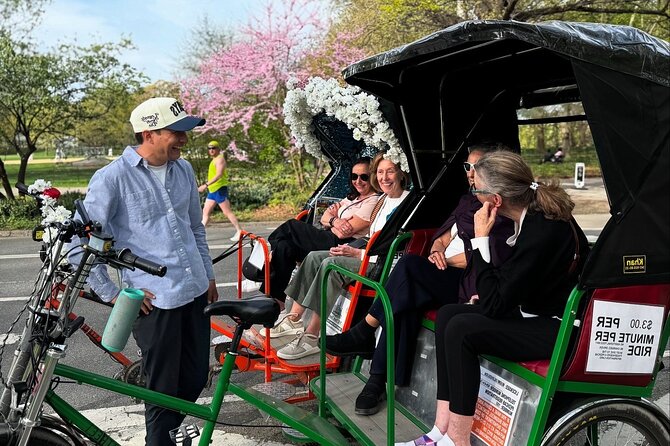
Central Park, but faster and with better photos. A private First Class pedicab loop lines up major landmarks and film-famous corners, with guided storytelling and built-in photo pauses.
I especially like the photo assistance and timing at the key viewpoints, so you’re not wrestling a crowd for angles. I also like how the ride reduces legwork, which matters when the weather is hot—or when New York is doing winter.
One consideration: the pace is designed to cover a lot, so each stop is short. If you want long, slow time at museums or for deeper zoo wandering, plan extra time after the ride.
In This Review
- Key takeaways before you ride
- Starting at 1415 6th Ave, and what the ride is really like
- Ricky’s approach: history, movies, and practical photo stops
- Central Park Carousel, Chess & Checkers House, and the Dairy House
- Wollman Rink and Gapstow Bridge: skyline views in a few minutes
- The Pond, Central Park Zoo, Balto, and Rumsey Playfield
- The Mall, Boathouse, Bethesda Fountain, and Bethesda Terrace tiles
- Cherry Hill Fountain, The Lake, and Bow Bridge
- Strawberry Fields, The Dakota, Sheep Meadow, and Tavern on the Green
- Pinebank Arch, Heckscher Playground, and Alice in Wonderland
- Cleopatra’s Needle, The Met, and Belvedere Castle on the longer option
- Price and value: is $39.20 worth it?
- Should you book this Central Park First Class Tour?
- FAQ
- How much does the tour cost?
- How long is the Central Park First Class Tour?
- Is this tour private?
- Where is the meeting point?
- Is the ticket mobile?
- What language is the tour offered in?
- How does the tour handle weather?
- Are there admission fees for the stops?
- Is tipping included?
- What if I need to cancel?
- Are service animals allowed?
Key takeaways before you ride
- Private pedicab for your group only: no sharing, no waiting for strangers.
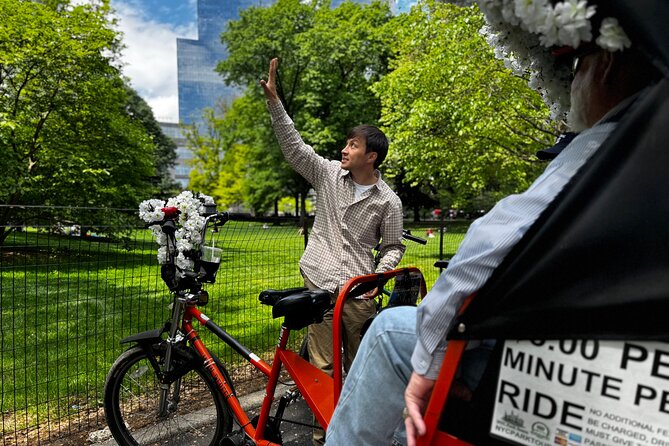
- Ricky’s storytelling adds context: he ties landmarks to movies, biographical details, and park design choices.
- VIP-style photo moments: you get help snapping pictures at famous spots, not just passing by.
- Season-ready comfort: shade in summer and blankets in winter keep the ride pleasant.
- Cover more ground than walking: you’ll see a long list of Central Park sights in a limited time.
More ways to see Central Park
- Central Park Pedicab Guided Tours
★ 5.0 · 7,108 reviews - Private Central Park Pedicab Tour
★ 5.0 · 6,981 reviews - NYC: Central Park Bike Rentals
★ 4.2 · 2,528 reviews - Official NYC Horse Carriage Rides in Central Park since 1979 ™
★ 5.0 · 2,365 reviews
Starting at 1415 6th Ave, and what the ride is really like
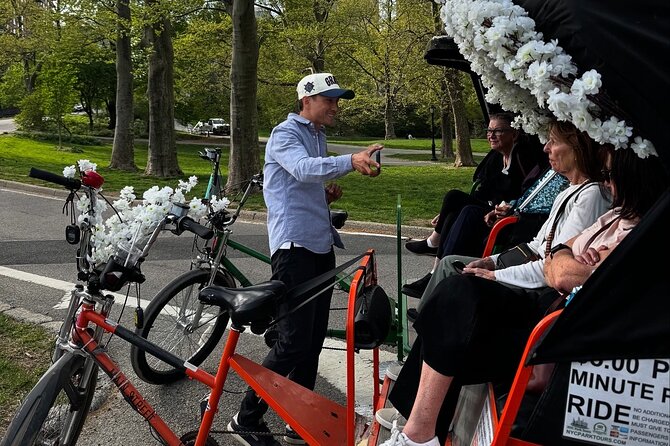
You meet at 1415 6th Ave, New York, NY 10019, and the tour ends back there. That makes it easy to plan the rest of your day, since you’re not committing to an end point far from transit.
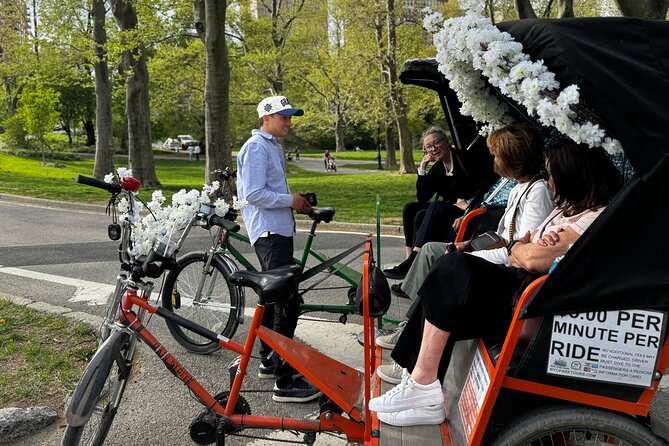
This is a private pedicab experience, so you’re not stuck in a line of other groups. The ride is built for comfort across seasons, with shade in summer and blankets in winter, which is a huge quality-of-life upgrade in a park that’s mostly outdoors.
The tour is also set up for convenience: you’ll use a mobile ticket, and everything runs in English. If you’re the type who likes getting your bearings fast, this format fits.
Ricky’s approach: history, movies, and practical photo stops
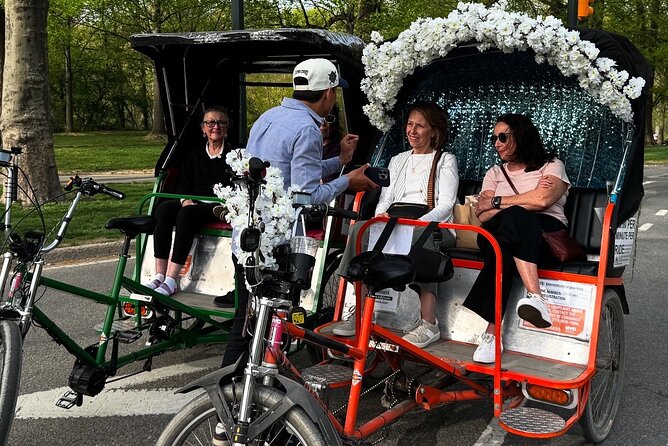
What makes this tour feel different is the guide’s rhythm: short stories, clear context, and lots of picture-ready moments. Ricky uses humor and detail so the park doesn’t just feel like scenery—it feels like a place with purpose.
You’ll also notice how he helps you work the light and the angle at the big-name spots. At places like Bethesda Fountain, Bow Bridge, and Strawberry Fields, the difference between a quick snapshot and a great photo is often timing—and that’s where Ricky’s pacing helps.
If you’re a movie fan, you’ll like the extra connections too. Several Central Park sites on this route show up in films and TV, and the guide uses those references to make the landmarks stick in your memory.
Central Park Carousel, Chess & Checkers House, and the Dairy House
The ride kicks off with a concentration of Central Park’s most recognizable “slow-life” attractions—places where people linger, not just pass through.
First, you’ll pause at the Central Park Carousel, a standout for both its age and its craftsmanship. The carousel has a layered past: the original concept dates to the late 1800s, while the current carousel was installed in 1951, and the current set of carved horses is known for being among the finest early 20th-century examples in the U.S.
Next comes the Chess & Checkers House, an octagonal brick building built in 1952 with 24 outdoor game tables. This is the kind of stop that works for everyone—from beginners learning checkers to serious chess players—because it’s part strategy, part community vibe.
Then you’ll see the Dairy House, originally built in 1870 and designed by Olmsted and Vaux as a refreshment spot. After it fell into disuse, restoration brought it back in the 1980s as a visitor center, so it’s both scenic and useful if you want maps and park info.
A good thing about these three stops together: they show Central Park as a designed social space, not only a green background for photos. The short time at each stop is ideal if you want variety without exhausting walking.
Worth a look right next to this New York City pick:
Wollman Rink and Gapstow Bridge: skyline views in a few minutes
Even if you’re not planning to ice skate, Wollman Rink is a must-see icon. It opened in 1950 and was named for Kate Wollman, who donated $600,000, creating a public skating destination with the Manhattan skyline as the backdrop.
Then you’ll roll to Gapstow Bridge, one of Central Park’s most photographed bridges. The current stone version dates to 1896, and the ivy-covered look with the pond views creates that classic “postcard” Central Park feeling.
Gapstow Bridge also gives you a nice mix of water and city: you can look toward the Midtown skyline while keeping the pond nature in frame. And because the area supports wildlife like ducks and turtles, it’s one of those stops where you might catch movement even if you’re just standing for a photo.
This is also a strong “reset” point in the tour. After busier areas, the bridge and pond give you a calmer pause.
The Pond, Central Park Zoo, Balto, and Rumsey Playfield
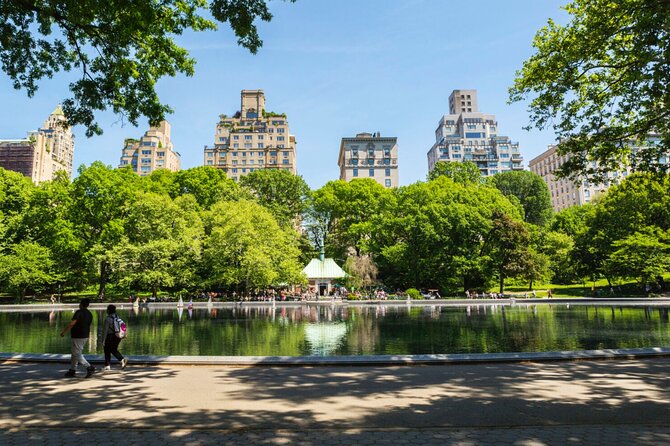
Central Park’s The Pond is the kind of place that makes you slow down without trying. It covers about 3.8 acres, and it’s landscaped as a changing scene of water, trees, and paths in the original Olmsted and Vaux design.
It also has cinematic identity. The Pond shows up in Home Alone 2: Lost in New York, including the famous pigeon-lady scene that most people recognize instantly.
Right after that, the tour route continues toward the Central Park Zoo, which has a long timeline. It started in 1864 as a small menagerie, became the city’s first official zoo in 1934 with WPA-built enclosures, and later shifted toward more natural habitats in 1988 under the Wildlife Conservation Society.
If you like animals, you’ll appreciate that the zoo’s exhibits are themed (like the Temperate Territory, Tropic Zone, and Polar Circle). You might spot animals such as penguins, sea lions, and snow leopards depending on the day.
Then you’ll see the Balto Statue, honoring the sled dog who helped deliver diphtheria antitoxin during the 1925 Serum Run to Nome. This is one of those stops where you get a story that feels bigger than the park itself, even though the statue is placed right in the middle of it.
Finally, there’s Rumsey Playfield, tied to the SummerStage outdoor concert program. The site has changed uses over time—from a small structure associated with park design to an Art Deco nightclub era, then to a sports field—before landing as a main stage for SummerStage performances.
This block of stops works well because it balances nature, animals, sports/music culture, and a real-world hero story. You don’t feel stuck in one theme.
The Mall, Boathouse, Bethesda Fountain, and Bethesda Terrace tiles
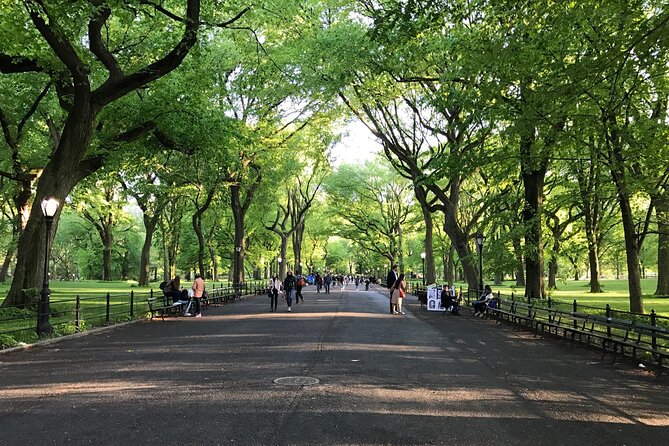
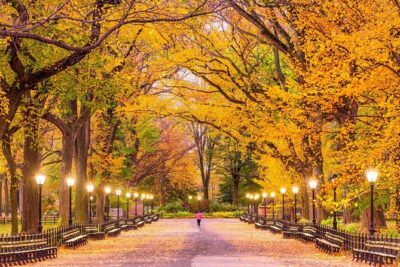
Next comes the park’s “walkable wow factor”—the Mall, also known as Literary Walk. It’s the only intentionally straight line in Central Park, designed by Olmsted and Vaux, and it’s shaded by tall American elms for a tunnel effect.
You’ll also get the literary angle here. The Mall is nicknamed Literary Walk because it hosts statues of major writers, and it’s an easy place to stop and read the names while your guide explains what you’re looking at.
From there, you’ll head toward the Central Park Boathouse, a strong photo stop with a cinematic past. The boathouse has appeared in Sex and the City and 27 Dresses, and the current building dates to 1956 after earlier structures were replaced.
If you’re visiting outside peak boating season, the boathouse still matters because it frames the Lake view. The building offers year-round dining, and heated outdoor seating is available so the scene stays usable even in colder months.
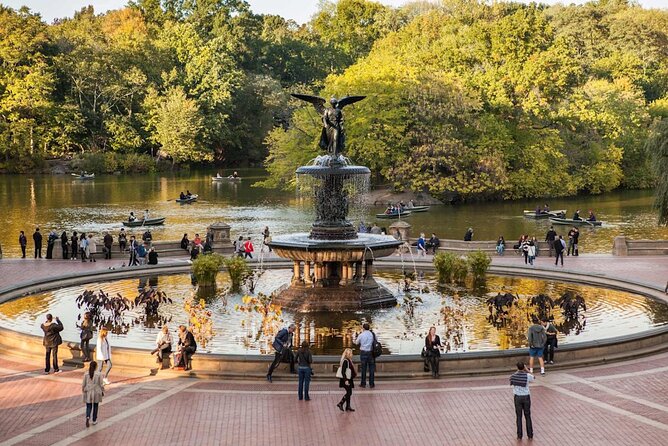
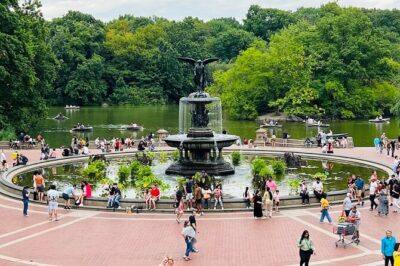
Then comes the centerpiece: Bethesda Fountain. At the center is The Angel of the Waters, designed by Emma Stebbins and unveiled in 1873. The statue’s symbolism ties to the Gospel story of the Pool of Bethesda, and it’s paired with cherubs representing health, purity, temperance, and peace.
Bethesda Fountain is also packed with pop culture appearances, including Home Alone 2 and Elf. That helps the stop land fast for first-time visitors—you feel like you already know it.
Right above/near it is Bethesda Terrace, famous for the Minton encaustic tile ceiling. Those tiles were installed in the 1860s, removed during a renovation when restoration costs were too high, and later restored after a long period in storage—reinstalled beginning in 2007 at a project cost reported as $7 million. You’ll see why that detail matters: the ceiling turns the terrace into something more than a scenic overlook.
This cluster is a high-value zone because it combines walking beauty (the Mall), water/restaurant energy (the Boathouse), major civic art (Bethesda Fountain), and restoration craftsmanship (Bethesda Terrace tiles).
Cherry Hill Fountain, The Lake, and Bow Bridge
You’ll then pass Cherry Hill Fountain, a circular plaza stop west of Bethesda Fountain. The fountain was built in the 1860s as a watering trough for horses, but today it functions more as a peaceful gathering spot—especially when visitors stop for photos with the lake in the background.
In Central Park, water is the “memory maker,” and The Lake is where it all connects. It’s about 20 acres and links key landmarks like the Ramble and Bethesda Terrace, which is why it feels like the park’s heart. If you want a water-view moment, you can row across the lake—Loeb Boathouse handles rentals nearby.
Finally, you’ll reach Bow Bridge, one of the park’s most romantic cast-iron bridges. It was completed in 1862 and designed by Calvert Vaux and Jacob Wrey Mould, and it has a curving “bow” profile that makes it a natural backdrop for couples and group photos.
Bow Bridge has had careful upkeep, including a major restoration in 1974 and a temporary closure for renovation in late 2023 into early 2024. That’s a subtle reminder: this is not just a pretty structure, it’s a maintained historic one.
If you’re short on time in New York, this is one of the most satisfying stretches. You get water, skyline, bridge architecture, and film-recognizable Central Park vibes without needing to plan a bunch of separate stops.
Strawberry Fields, The Dakota, Sheep Meadow, and Tavern on the Green
Central Park’s emotional center shows up at Strawberry Fields, the 2.5-acre memorial dedicated to John Lennon. The site was designed as a living tribute and features the Imagine mosaic, inspired by Lennon’s vision of peace.
You’ll also learn how the memorial’s name connects to Strawberry Fields Forever, and how the Imagine mosaic was gifted by Naples, Italy. Even if you’re not a Beatles superfan, this is one of the most meaningful stops because it’s simple and human-scale.
Next you’ll see the Dakota, the famous building at 72nd Street and Central Park West. It’s known for its Renaissance Revival style, and over the years it’s been home to major figures including John Lennon and Yoko Ono; Lennon’s death outside the building is part of its modern story. The Dakota’s exterior also appears in Rosemary’s Baby, which makes the building feel like a real character in New York’s cultural history.
Then comes Sheep Meadow, a big open lawn at the south end of the park. It used to be a grazing area for sheep, and today it’s one of the best “sit and recharge” places in Central Park, especially with the skyline as contrast.
Sheep Meadow has film moments too, including Ghostbusters and Wall Street. That’s useful if you like places that feel both real and story-loaded.
You’ll also pass Tavern on the Green area. The building’s history is tied to the sheepfold built in 1870, and the sheep were evicted from that sheepfold in 1934 under NYC Parks commissioner Robert Moses. After closure and renovation, the restaurant reopened in 2014.
This section is ideal for people who want more than a list of landmarks. It gives you a mix of art memory (Strawberry Fields), architectural icon (the Dakota), open-space calm (Sheep Meadow), and classic Central Park dining history.
Pinebank Arch, Heckscher Playground, and Alice in Wonderland
Some Central Park stops are famous. Others feel like they’re for people who notice details. Pinebank Arch fits the second category, even though you might recognize it from pop culture: it appeared in Elf.
It’s a cast-iron bridge meant to blend into rocky outcrops, with delicate ironwork that makes it feel almost light against the trees. You’ll likely find yourself pausing there longer than planned, just to look at the way it matches the terrain.
You’ll then see Heckscher Playground, close to Central Park South between Sixth Avenue and Seventh Avenue. It’s the oldest and largest of Central Park’s 22 playgrounds, opened in 1926 and named for philanthropist August Hecksche.
If you’re traveling with kids, this stop is a nice energy shift. It’s also a reminder that Central Park is a family place, not only a sightseeing route.
For longer timing, you may include the Alice in Wonderland statue, donated in 1959 by George Delacorte. The statue depicts Alice sitting on a giant mushroom with characters like the Mad Hatter, Cheshire Cat, and White Rabbit, and children are encouraged to climb and interact with it.
If you’ve got a family in the group, this area is often where people end up smiling because it turns a statue into play.
Cleopatra’s Needle, The Met, and Belvedere Castle on the longer option
If you choose the longer 2-hour-style experience, you’ll also get key “big city next to the park” hits.
One is Cleopatra’s Needle, the oldest outdoor monument in New York City, dating back more than 3,500 years. It originated in Egypt, moved through ancient cities over centuries, and was gifted to the United States, then dedicated in Central Park in 1881 between the Great Lawn and the Metropolitan Museum of Art.
You’ll also see The Metropolitan Museum of Art (The Met), founded in 1870 and opened in 1880 along Central Park’s eastern edge. The museum has grown over time, and it houses over 2 million works spanning about 5,000 years of human history.
Another included stop on the longer route is the Jacqueline Kennedy Onassis Reservoir, built between 1858 and 1862 to expand the city’s receiving reservoir capacity. It covers about 106 acres, is around 40 feet deep, and holds more than one billion gallons, with three gatehouses along the shore.
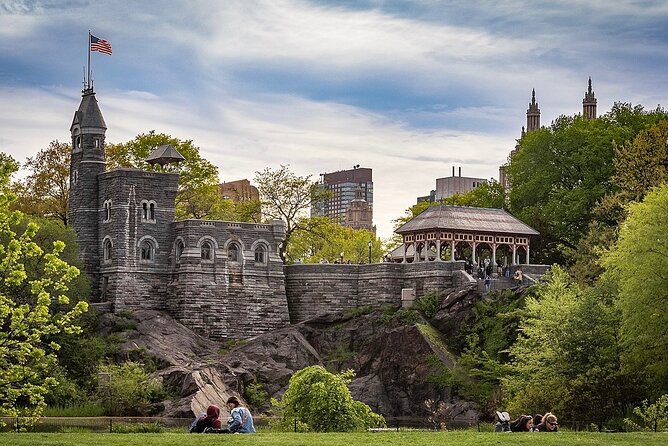
Then there’s Belvedere Castle, designed in 1867 as a decorative folly by Calvert Vaux and Jacob Wrey Mould. It has an observation deck with views of places like Turtle Pond, the Great Lawn, and the Ramble, and it has served as the location for Central Park’s official weather station since 1919.
This longer portion is the best fit for you if you want Central Park to feel connected to the rest of Manhattan, not isolated from it.
Price and value: is $39.20 worth it?
At $39.20 per person, you’re paying for more than a ride. You’re paying for a private guide, photo help, and the ability to hit a lot of iconic places without exhausting walking.
That matters in a park like Central Park, where “just walking” can turn into a long day with sore feet and missed viewpoints. The pedicab format also gives you a practical advantage: it’s faster than foot travel while still allowing short pauses for photos and stories.
Value also comes from the guide’s approach. Ricky doesn’t only point; he explains why the fountain or bridge matters, and he connects it to art, design, and pop culture moments you’ll likely remember later. That’s the difference between collecting images and understanding what you’re seeing.
Also, because this is booked fairly ahead on average (about a month in advance), you’ll get better odds at your preferred time by reserving early.
Should you book this Central Park First Class Tour?
Book it if you want iconic Central Park in a tight window, prefer a comfortable pace, and love photo moments with help from a guide. It’s a great match for first-time visitors, families, people visiting in winter, and movie fans who like seeing where famous scenes were filmed.
Skip it—or plan extra time after—if you want long stays at the zoo, a slow museum-style experience, or a deep browse where every stop takes 30–60 minutes. This tour’s strength is coverage and story pacing, not extended wandering.
If your goal is to see the park’s big hits, learn the why behind them, and leave with photos that look like you planned the whole day—this one makes a lot of sense.
FAQ
How much does the tour cost?
The price is $39.20 per person.
How long is the Central Park First Class Tour?
It runs about 1 to 3 hours, depending on the option you choose.
Is this tour private?
Yes. It’s a private activity for your group only.
Where is the meeting point?
You meet at 1415 6th Ave, New York, NY 10019, and the tour ends back at the same meeting point.
Is the ticket mobile?
Yes, the tour uses a mobile ticket.
What language is the tour offered in?
The tour is offered in English.
How does the tour handle weather?
The experience requires good weather, and it’s designed to be comfortable in different seasons with shade in summer and blankets in winter.
Are there admission fees for the stops?
Some stops are listed as free (for example Wollman Rink, Gapstow Bridge, and several others), and the tour also notes admission ticket inclusion for the Central Park portion at the start. The exact mix depends on the stops covered in your time option.
Is tipping included?
Tipping is not included, though it’s optional.
What if I need to cancel?
Free cancellation is available up to 24 hours in advance for a full refund. If canceled less than 24 hours before, the amount paid is not refunded.
Are service animals allowed?
Yes, service animals are allowed.
More Tours in New York City
- Statue of Liberty and Ellis Island Tour: All Options★ 5.0 · 13,571 reviews
- New York in One Day Guided Sightseeing Tour★ 5.0 · 13,166 reviews
- Central Park Pedicab Guided Tours★ 5.0 · 7,108 reviews
- New York City: Manhattan Helicopter Tour★ 4.7 · 7,076 reviews
- Private Central Park Pedicab Tour★ 5.0 · 6,981 reviews
More Tour Reviews in New York City
- NYC: SUMMIT One Vanderbilt Tickets★ 4.7 · 51,195 reviews
- NYC: Empire State Building Tickets – Observatory & Museum★ 4.7 · 25,757 reviews
- New York City: Statue of Liberty & Ellis Island with Ferry★ 4.6 · 18,683 reviews
- New York City: American Museum of Natural History Ticket★ 4.5 · 15,447 reviews
- Statue of Liberty and Ellis Island Tour: All Options★ 5.0 · 13,571 reviews
More of Central Park
- Central Park Pedicab Guided Tours★ 5.0 · 7,108 reviews
- Private Central Park Pedicab Tour★ 5.0 · 6,981 reviews
- NYC: Central Park Bike Rentals★ 4.2 · 2,528 reviews
- Official NYC Horse Carriage Rides in Central Park since 1979 ™★ 5.0 · 2,365 reviews
- NYC: Central Park Bike Rental★ 4.1 · 1,651 reviews
Just in: the newest New York City reviews on our desk

Central Park Tours, compared.
 ★ 5.0Central Park Pedicab Guided ToursFrom $387,108 reviews
 ★ 5.0Private Central Park Pedicab TourFrom $386,981 reviews
 ★ 4.2Central Park Bike RentalsFrom $92,528 reviews
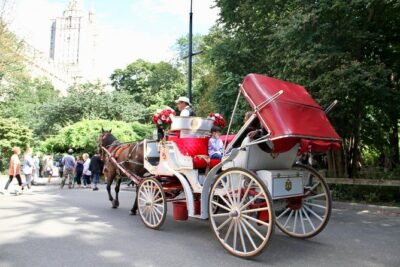 ★ 5.0Official NYC Horse Carriage Rides in Central Park since 1979 ™From $992,365 reviews
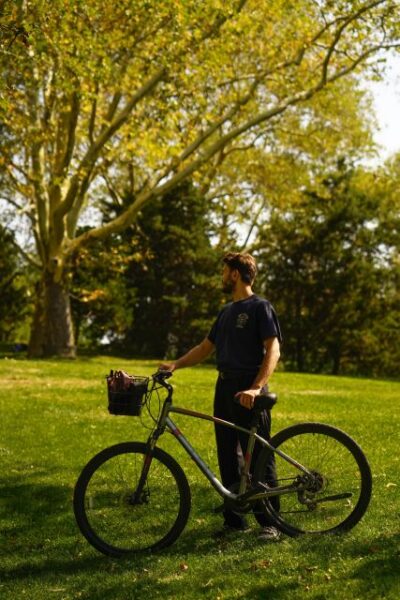 ★ 4.1Central Park Bike RentalFrom $81,651 reviews
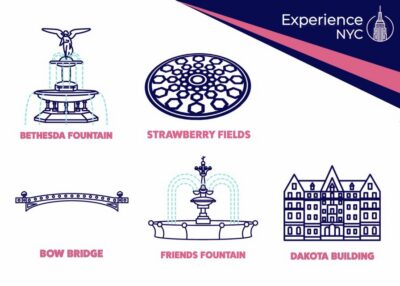 ★ 4.9Private Central Park Pedicab TourFrom $401,637 reviews
 ★ 4.7Central Park Bike RentalFrom $91,509 reviews
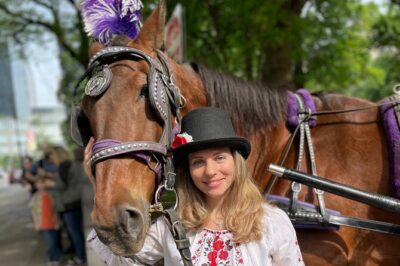 ★ 4.0Carriage Ride in Central Park (VIP – PRIVATE) Since 1964™From $141,074 reviews
Browse the lists this tour appears in