
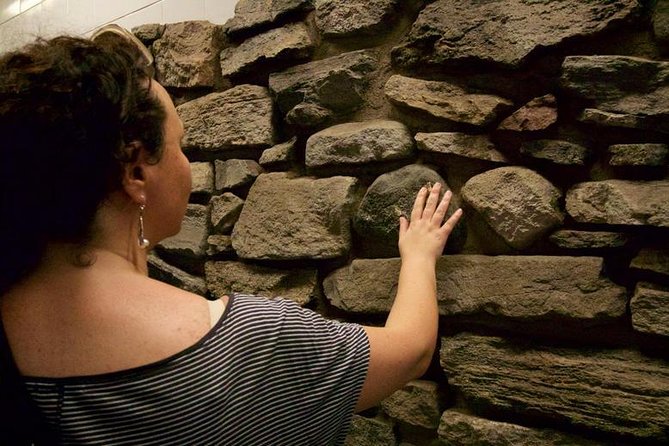
Reviewed · TOURS
Lower Manhattan Tour: The Remnants of Dutch New Amsterdam!
Dutch roots, right under your feet.
This Lower Manhattan tour is a walk through the remnants of New Amsterdam, with a small group vibe and the comfort of provided ear pieces so you catch every story. I especially like how the route strings together the founding story you’d miss if you only pop between landmarks, and how the guide gives extra context at places like Bowling Green and Wall Street. The main drawback: it’s still a 3.5-hour walking tour, so plan for the weather and wear shoes you trust.
You’ll start at the National Museum of the American Indian and then move through the Financial District with an easy rhythm that stays focused on what those streets used to be. Stops are short and built for learning without dragging (5 to 15 minutes each early on), and the total tour keeps you south of Wall Street. You should consider this if you want old-city context in a busy area, not if you’re chasing nonstop photo stops.
One more reason I think this tour works: it’s designed for attention. With a maximum of 10 travelers, you’re more likely to ask questions and keep up with the timeline as the guide connects Dutch New Amsterdam to the modern skyline. Expect a route that helps you get your bearings fast and understand why the harbor mattered.
In This Review
- Key Highlights You’ll Actually Feel on the Walk
- Following Dutch New Amsterdam Through Modern Lower Manhattan
- Starting at the National Museum of the American Indian: The Tone Setter
- Bowling Green: Where the Dutch Left a Name and a Power Signal
- The NYSE, Fearless Girl, and a Quick Snapshot of Market Power
- Stone Street: Stepping Back Without Leaving the Financial District
- Wall Street and the Off-Street Details You’d Miss
- Lower Manhattan’s Core Story: South of Wall Street, Past the Obvious
- How the Harbor and Founding Choices Shaped Everything
- Guides, Ear Pieces, and Why a Max-10 Group Feels Easier
- Timing and Comfort: Plan for 3.5 Hours on Your Feet
- Price and Value: Why $39 Can Make Sense Here
- Who Should Book This Tour (And Who Might Want to Pass)
- Should You Book the Remnants of Dutch New Amsterdam Tour?
- FAQ
- Where does the tour start?
- What time does the tour begin?
- How long is the tour?
- How much does it cost?
- Is the tour offered in English?
- What group size should I expect?
- Are ear pieces provided?
- Are admissions included at the stops listed?
- What is the cancellation policy?
- Is the tour near public transportation?
Key Highlights You’ll Actually Feel on the Walk

- A licensed NYC tour guide, not just a casual stroll with random facts
- Ear pieces provided, so the busy sidewalks won’t block the narration
- A tight group size (max 10) for a more relaxed pace and personal attention
- Dutch New Amsterdam context at real street corners, including Bowling Green and Stone Street
- A classic Wall Street finish with stops near the NYSE, Fearless Girl, and the bull
- All-in feel for $39 since the tour portion at listed stops shows admission as free
Not sold yet? Here is how this one lines up against other New York City picks:
- NYC: SUMMIT One Vanderbilt Tickets
★ 4.7 · 51,195 reviews - NYC: Empire State Building Tickets – Observatory & Museum
★ 4.7 · 25,757 reviews - New York City: Statue of Liberty & Ellis Island with Ferry
★ 4.6 · 18,683 reviews - New York City: American Museum of Natural History Ticket
★ 4.5 · 15,447 reviews
Following Dutch New Amsterdam Through Modern Lower Manhattan

Lower Manhattan can feel like a blur: towers, rush hour, and a lot of people moving fast. This tour slows that down on purpose, turning the streets into clues. You’ll learn how early settlement decisions shaped what became New York, and you’ll get the sense that the city has layers, not just a single story.
What I like most is that the tour doesn’t treat Dutch history like a trivia detour. It frames why these specific locations mattered, which makes places you’ve seen before feel newly legible. And since the entire walk happens south of Wall Street, you’re staying in the geographic story, not hopping around Manhattan.
A small note for your expectations: this is about interpretation more than museum time. The stop durations are brief, so you should come ready to listen and walk.
Starting at the National Museum of the American Indian: The Tone Setter
The tour begins at the National Museum of the American Indian for a short first stop. It’s listed as 15 minutes with admission shown as free for this tour portion, which helps you start without adding cost or complications.
Even if you’re not planning a deep museum visit, this starting point matters. It gives you a broader sense of New York’s founding-era context before the route narrows into Dutch New Amsterdam. It’s a good way to sharpen your listening so that later stops connect to the bigger picture.
If you’re arriving early, you’ll likely find time to orient yourself nearby. Just don’t overpack the pre-walk with extra plans—you’ll lose time and focus.
Bowling Green: Where the Dutch Left a Name and a Power Signal
Next up is Bowling Green, a 15-minute stop with admission listed as free. This is where the tour starts making the Dutch feel real, not abstract. You’ll learn how Bowling Green got its name and why it was important to the Dutch.
Bowling Green is the kind of place people rush through because it looks like part park, part plaza. The tour changes that by explaining the meaning behind the setting—how a public space fits into the early city’s needs. That context turns a central square into a historical anchor.
Practical tip: this area can be busy, so keep an eye on where the group gathers. With ear pieces involved, you’ll hear the guide even when foot traffic is loud, but you still want to stay oriented.



The NYSE, Fearless Girl, and a Quick Snapshot of Market Power
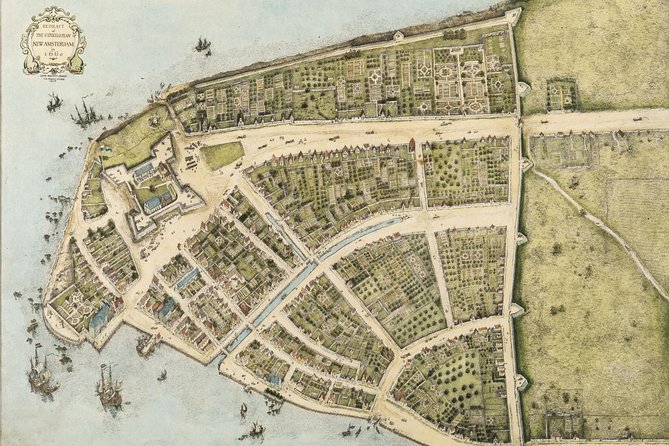
Then you head to the New York Stock Exchange area for a 5-minute stop, still with admission listed as free. The focus here is history—what the NYSE represents, and how it links to the city’s evolving financial identity.
You’ll also walk past Fearless Girl, which you’ll see now facing the NYSE. That’s a small moment, but it works well in a Dutch New Amsterdam tour because it connects “then” and “now” in one glance: a modern icon standing across from the institutions that grew in the same neighborhood.
This is one of the shortest stops, so if you’re the type who wants lots of time to read plaques, be aware. The tradeoff is that the tour keeps the pace moving toward the more grounded “street-level history.”
Stone Street: Stepping Back Without Leaving the Financial District
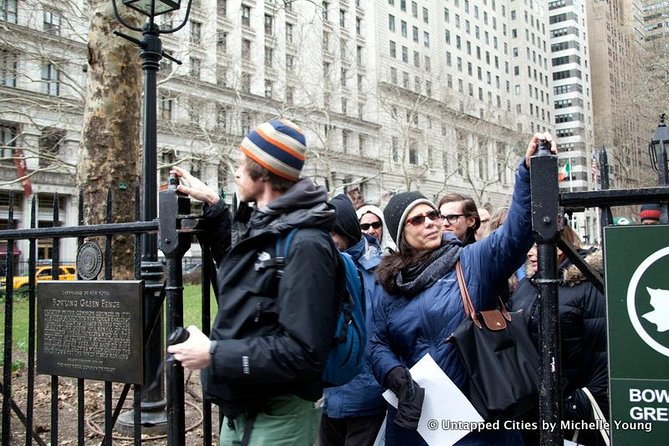
Stone Street is next, and it’s a favorite kind of stop for a reason. It’s listed as 15 minutes and described as a gem hidden inside the Financial District. In other words: you’re in Lower Manhattan, but the feel changes.
The tour’s goal here is to help you recognize the street as a time capsule. As you walk, you’re not just looking at buildings—you’re learning how this kind of old streetscape connects to New Amsterdam’s early urban form.
If you like photos, this is likely your best chance to capture that “how is this here?” contrast. Just don’t treat it as a free time stop; stay close and listen so you get the meaning, not only the scenery.
Wall Street and the Off-Street Details You’d Miss
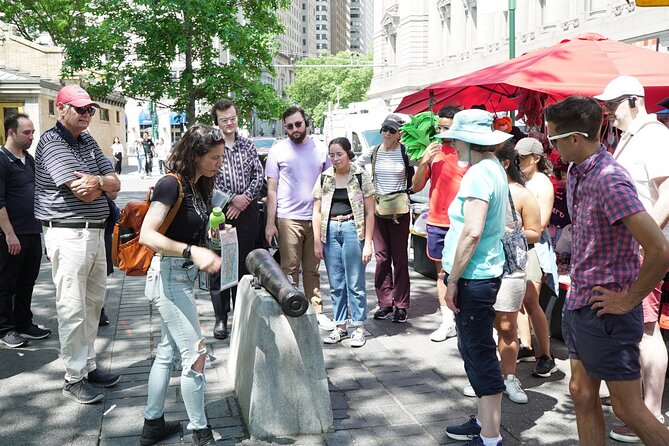
You’ll then spend 15 minutes on Wall Street plus nearby areas, exploring hidden gems both on and off the main strip. The idea is simple: the “big” Wall Street landmarks are obvious, but the smaller details are where the story gets interesting.
This stop is about pattern recognition. You’ll see how the city’s early footprint influences the layout and how the Dutch era connects to the later commercial mindset. It’s also a chance for the guide to point out spots you’d probably walk right by if you were going DIY.
In past outings led by local historians like Mandy, the tone has been enthusiastic and story-driven, with the guide using added references and materials to help the city feel like it had a 17th-century rhythm. If you end up with a guide who does that, you’ll feel the difference immediately.
Lower Manhattan’s Core Story: South of Wall Street, Past the Obvious
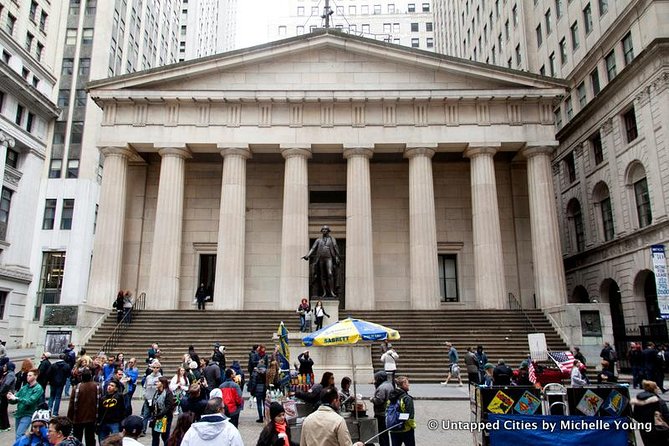
About an hour of the tour is spent in Lower Manhattan, specifically south of Wall St, listed as 1 hour. This is where the walking becomes more narrative and less stop-and-start.
You’ll learn how New York became New York, not just that it was founded. The route keeps you moving through the core geography so the story doesn’t float. And because it stays in the same general zone, you start to understand how the city’s layout supports the history.
This is also where the harbor role comes in. The tour specifically includes discovering the role of the harbor in developing New York City. That’s an important piece, because the harbor wasn’t just scenery—it was the engine.
How the Harbor and Founding Choices Shaped Everything
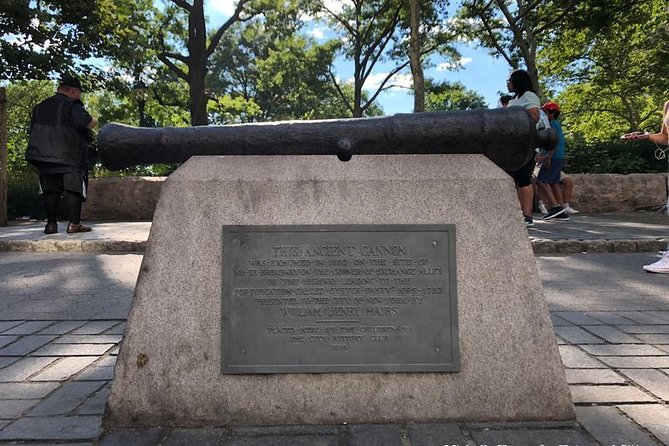
The tour ends with another 1 hour segment labeled around discovering how New York became New York, including the harbor connection. This final stretch is your chance to tie together what you learned earlier at Bowling Green, Stone Street, and the Wall Street institutions.
Think of it like this: the early Dutch city needed trade access, movement of goods, and settlement logic that made sense along the water. Once you understand that, you start seeing modern Lower Manhattan as a continuation—not an unrelated jumble.
The walk also ends at famous Wall Street imagery: you’ll end at the bull. There’s something satisfying about closing a founding-focused tour on an icon of modern finance. It’s not subtle, but it’s memorable.
Guides, Ear Pieces, and Why a Max-10 Group Feels Easier
A big part of the tour’s quality is the delivery. You get a guided walking tour with a licensed NYC tour guide, and ear pieces are provided so everyone can hear clearly.
That matters more than it sounds in Lower Manhattan. You’re walking near major traffic and dense footpaths, and bad audio can ruin the whole experience. With ear pieces, you can relax your attention and focus on the story rather than asking your neighbor to repeat themselves.
Group size also helps. With a maximum of 10 travelers, the pace stays comfortable, and the guide can check in and adjust on the fly. Guides have been described as locally grounded and proactive—like Richard, who has been noted for being diligent about checking in with the group and giving recommendations after the tour. Another guide name that’s come up is Gabbie, praised for enthusiasm and knowledgeable storytelling about New Amsterdam.
No matter who’s leading your day, this format is designed to keep the walk from turning into a loud shuffle.
Timing and Comfort: Plan for 3.5 Hours on Your Feet
The tour runs about 3 hours 30 minutes. The itinerary includes several short stops early (5 to 15 minutes), then longer segments that keep the narrative moving as you walk.
So yes, it’s longer than the typical “grab photos and go” neighborhood tour. Come prepared with comfortable walking shoes. If the weather is rough, you’ll feel it more because there’s no “sit down and wait” museum structure built in—this is a true street walk.
You might also want a light layer. Lower Manhattan can be windy near the water-side portions, and the city doesn’t always care about your schedule.
Price and Value: Why $39 Can Make Sense Here
At $39 per person for roughly 3.5 hours, this isn’t just paying for someone to point at buildings. You’re paying for a licensed guide, a structured route through key Dutch-related areas, and ear pieces so you can actually hear the explanation.
Another value lever: the listed stops show admission as free for the tour. That matters because many city tours sneak in extra ticket costs later. Here, the cost stays predictable.
You should also know that the tour is booked well ahead on average (around 28 days in advance). If you’re visiting during a peak period, booking early can reduce stress and help you lock in the start time.
Who Should Book This Tour (And Who Might Want to Pass)
This tour is a strong fit if you:
- Love New York history but want it anchored to real places you can walk
- Want help understanding the city’s early development without doing heavy research
- Appreciate a relaxed pace with a small group
It can also be a good option for families, especially if you like stories and walking together. Solo travelers tend to like this format because ear pieces make it easier to stay engaged, and the max-10 group reduces the feeling of being swallowed by a crowd.
You might want to skip it if you only want quick “must-see” stops and no extra context. The tour’s value is interpretation and narrative, not just scenery.
Should You Book the Remnants of Dutch New Amsterdam Tour?
I think you should book this tour if you want your Lower Manhattan visit to make sense at street level. For $39, you get a clear route through key areas tied to New Amsterdam, and the audio setup plus small group size make it easier to actually hear the story.
If you’re the type who likes to understand why a city looks the way it does, this is a smart use of time. If you’re just trying to cover ground and don’t care about the Dutch layer, you could DIY nearby with a map—though you’d likely miss the “why this place mattered” thread.
My practical call: if you want a guided explanation of early New York without museum-heavy scheduling, this one is a solid pick. And when you finish at the bull, you’ll have the satisfaction of knowing what you walked through, not only where you ended up.
FAQ
Where does the tour start?
The tour starts at Bowling Green, New York, NY 10004.
What time does the tour begin?
The start time listed is 2:00 pm.
How long is the tour?
The duration is approximately 3 hours 30 minutes.
How much does it cost?
The price is $39.00 per person.
Is the tour offered in English?
Yes, the tour is offered in English.
What group size should I expect?
The tour has a maximum of 10 travelers.
Are ear pieces provided?
Yes. Ear pieces are provided to each guest.
Are admissions included at the stops listed?
The stops are listed with admission shown as free for the tour portion (including the National Museum of the American Indian, Bowling Green, and the listed stops afterward).
What is the cancellation policy?
You can cancel for a full refund up to 24 hours in advance of the experience start time. Canceling less than 24 hours before start is not refundable.
Is the tour near public transportation?
Yes, it’s near public transportation. Service animals are allowed, and most travelers can participate.
More Tours in New York City
- Statue of Liberty and Ellis Island Tour: All Options★ 5.0 · 13,571 reviews
- New York in One Day Guided Sightseeing Tour★ 5.0 · 13,166 reviews
- Central Park Pedicab Guided Tours★ 5.0 · 7,108 reviews
- New York City: Manhattan Helicopter Tour★ 4.7 · 7,076 reviews
- Private Central Park Pedicab Tour★ 5.0 · 6,981 reviews
More Tour Reviews in New York City
- NYC: SUMMIT One Vanderbilt Tickets★ 4.7 · 51,195 reviews
- NYC: Empire State Building Tickets – Observatory & Museum★ 4.7 · 25,757 reviews
- New York City: Statue of Liberty & Ellis Island with Ferry★ 4.6 · 18,683 reviews
- New York City: American Museum of Natural History Ticket★ 4.5 · 15,447 reviews
- Statue of Liberty and Ellis Island Tour: All Options★ 5.0 · 13,571 reviews
Just in: the newest New York City reviews on our desk





Tours, compared.
 ★ 5.0Statue of Liberty and Ellis Island Tour: All OptionsFrom $6913,571 reviews
 ★ 5.0New York in One Day Guided Sightseeing TourFrom $9913,166 reviews
 ★ 5.0Central Park Pedicab Guided ToursFrom $387,108 reviews
 ★ 4.7Manhattan Helicopter TourFrom $2997,076 reviews
 ★ 5.0Private Central Park Pedicab TourFrom $386,981 reviews
 ★ 5.09/11 Memorial, Ground Zero Tour with Optional 9/11 Museum TicketFrom $396,381 reviews
 ★ 4.2Hop-on Hop-off Sightseeing Tour by Open-top BusFrom $445,863 reviews
 ★ 4.8Manhattan Sightseeing Helicopter TourFrom $2995,826 reviews