
Reviewed · NYC BIKE TOURS
Lower Manhattan Bike Tour
Pedal power makes Lower Manhattan make sense. This guided ride strings together iconic sights with real street-level perspective, so you can see a lot without getting tangled in downtown chaos on your own. I like that it’s small-group and guide-led, with bikes and helmets handled for you.
What I really like most is the hands-on attention: with a max of 6 riders, you’re not stuck watching from the back. I also appreciate that bikes and helmets are included, which turns the tour into a straightforward plan instead of extra rental errands.
One consideration: you’ll bike about 8 miles at a pace set by the group, and the tour asks for moderate fitness and a minimum height of 5 feet (152.4 cm). If that’s not you yet, you may want to go slower—or choose something shorter.
In This Review
- Key highlights you’ll feel during the ride
- Why this Lower Manhattan bike route works in a half-day
- Price and value: what $98 buys you here
- Start strong: meeting point, mobile ticket, and first-bike confidence
- From the Brooklyn Giro Bike Tours start toward the Manhattan Bridge
- Along the East River Esplanade under the FDR
- South Street Seaport Historic District and the Titanic Memorial Park pass-by
- City Hall Park, then into the financial core
- Charging Bull and Trinity Church: iconic stops with easy orientation
- Battery Park views: ferry terminals, Anne Seton, and the Hudson River Greenway
- One World Trade Center and the Stone & Pearl Streets shift
- Municipal Building and Civic Fame on the way back
- Riding tips that make this tour easier
- Who this tour suits best
- Should you book this Lower Manhattan Bike Tour?
- FAQ
- How long is the Lower Manhattan Bike Tour?
- How much does the tour cost?
- Is the tour in English?
- How many people are in the group?
- What is included in the price?
- Are there any height requirements?
- How far do you bike during the tour?
- Where does the tour start and end?
- Can I cancel for a full refund?
Key highlights you’ll feel during the ride
- Up to 6 riders means you get real guidance and quick answers while you roll
- Bikes and helmets provided, so you can show up and ride
- A tight Lower Manhattan loop that includes bridges, riverfront, Wall Street, and Battery Park
- No extra admission surprises at the stops listed (they’re ticket-free)
- English-speaking guide to keep the story clear as you pass each landmark
Two wheels through New York City: more rides
- NYC: Central Park Bike Rentals
★ 4.2 · 2,528 reviews - NYC: Central Park Bike Rental
★ 4.1 · 1,651 reviews - Central Park Bike Rental
★ 4.7 · 1,509 reviews - New York City: Highlights of Central Park Bike or eBike Tour
★ 4.6 · 800 reviews
Why this Lower Manhattan bike route works in a half-day
Lower Manhattan can feel like a greatest-hits album—until you try to assemble it yourself. This tour solves the main problem fast: getting from landmark to landmark efficiently while someone else handles the street logic.
The best part is that you don’t just see famous names. You also get motion—crossing the river area, sliding along water, and cutting through the grid with context from a local guide. That turns the skyline into a route you understand, not just a list.
You’ll also like the pacing if you’re trying to start your NYC stay with confidence. You get a “here’s how downtown fits together” overview, and then you can roam on your own later with way less guesswork.
Price and value: what $98 buys you here
At $98 per person for roughly 3 hours 30 minutes, the value is about what’s included and what it saves you.
You’re getting:
- a local guide
- a bike
- a helmet
On a city day where bike rentals, helmet rentals, and time spent coordinating can add up, this is an easy package. The tour also lists the major stops with ticket-free admission, so you’re not stacking extra paid entries into your afternoon.
This is a smart choice if you want a guided overview that still leaves you time afterward to eat, shop, or wander without rushing.
Start strong: meeting point, mobile ticket, and first-bike confidence
The tour starts in Lower Manhattan (New York, NY 10002) and ends back at the same meeting point. It’s set to begin at 12:00 pm, which is convenient if you want a daytime anchor before evening plans.
Bring a mobile ticket on your phone. You’ll also want to plan on one key rule: you must be at least 5 feet tall to ride. That’s not just a formality—small-group bike tours need fit and control to keep things safe.
Once you’re rolling, the tone matters. In the ride feedback, guides like Frank and Tom are called out for making the experience feel friendly and organized—so you can focus on the scenery instead of panicking about your balance.
Worth a look right next to this New York City pick:
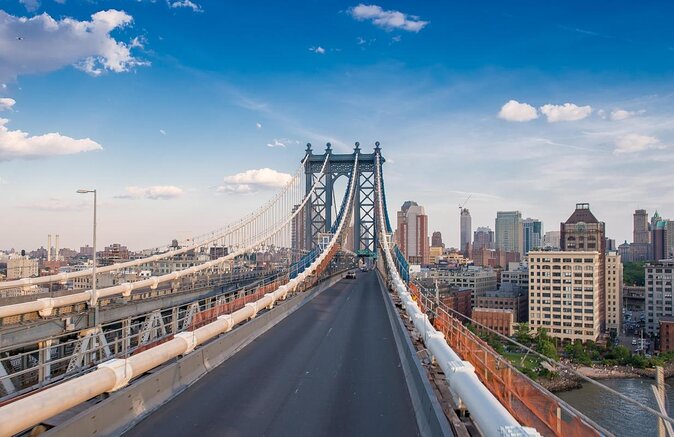
From the Brooklyn Giro Bike Tours start toward the Manhattan Bridge
You kick things off at Brooklyn Giro Bike Tours, then head toward one of the first big “wow” moments: the Manhattan Bridge.
This opening segment is valuable because it sets the route rhythm. You’re not yet deep into Wall Street’s density; you’re getting oriented and learning how the group moves together. Then the bridge becomes a natural hinge point—great for taking in skyline angles and seeing how different parts of downtown link up.
If you’re worried about getting lost later, this is the segment that helps you build a map in your head. Bridges are like downtown’s connectors; the guide uses them to explain how neighborhoods relate.
Along the East River Esplanade under the FDR
Next you ride the East River Waterfront Esplanade, including time under the FDR. This part is often where a bike tour turns from sightseeing into something more pleasant.
Why it works:
- You get a river-side stretch that feels less gridlocked than inland streets.
- You’re moving with a view corridor, so photos and orientation come easier.
- The route under the FDR gives you that classic NYC under-highway feel, with the ride still feeling controlled.
You’ll understand the geography faster here than on a quick walk. Even if you’re not a serious cyclist, the open stretch helps you settle in and keep a steady pace.
South Street Seaport Historic District and the Titanic Memorial Park pass-by
After the river stretch, you head toward the South Street Seaport Historic District. It’s an area that immediately changes the vibe: more historic, more textured, more “this is where the city’s old waterfront energy lived.”
Then you pass by Titanic Memorial Park. The value of this stop is less about being a museum moment and more about recognition. You’re biking past a specific landmark tied to maritime memory, in a spot that matches the river-and-ports story your eyes are already primed for.
If you like your NYC sightseeing with a thread, this pair of stops gives it. You’re not just checking boxes—you’re seeing how Lower Manhattan’s waterfront identity shifts through time.
City Hall Park, then into the financial core
From there, the route moves to City Hall Park. This is one of those places you can see from the bike seat without needing a long stop. It helps connect civic space to the commercial intensity that comes right after.
And then you roll into Wall Street and nearby highlights—this is the core of the downtown “I can’t believe I’m here” effect. You’ll be cycling through the streets where the city’s financial identity is concentrated, with a guide pointing out what you’re actually looking at as you pass.
In a crowd, Wall Street can feel like a rush of people and signs. On a bike with a guide, it becomes clearer. You’re moving at a pace that still lets you read the scene.
Charging Bull and Trinity Church: iconic stops with easy orientation
Two of the most recognizable names on the route are Charging Bull and Trinity Church NYC.
Charging Bull is a quick, high-recognition photo stop. The benefit on a bike tour is that you get there as part of a flow, not as a mission that steals your whole afternoon.
Trinity Church adds a different kind of payoff. It’s not just a landmark; it anchors the historic-religious side of downtown that sits alongside the financial story. When you move through both, it clicks how many layers exist in a small geographic area.
This is also where the small-group size really helps. You’re not competing with 200 people for a glance. You get to look, roll, and keep going—without losing the bigger picture.
Battery Park views: ferry terminals, Anne Seton, and the Hudson River Greenway
Then the tour heads to Battery Park, where you get a set of big-picture views. The route includes sightlines of the Staten Island Ferry Terminal, the Shrine of Anne Seton, and the Museum of the American Indian, plus cycling along the Hudson River Greenway to Roosevelt Park.
That list matters because it’s not random. It shows you how Lower Manhattan’s waterfront connects transportation, cultural institutions, and park space.
Even if you’re not planning a ferry ride that day, seeing the ferry terminal from the bike seat helps you understand how the city’s water network works. And the Hudson River Greenway section gives you a more open feeling than the dense streets inland.
This part is also practical. You’re outside the tightest downtown pressure, so it’s a good moment to reset your attention and enjoy the ride.
One World Trade Center and the Stone & Pearl Streets shift
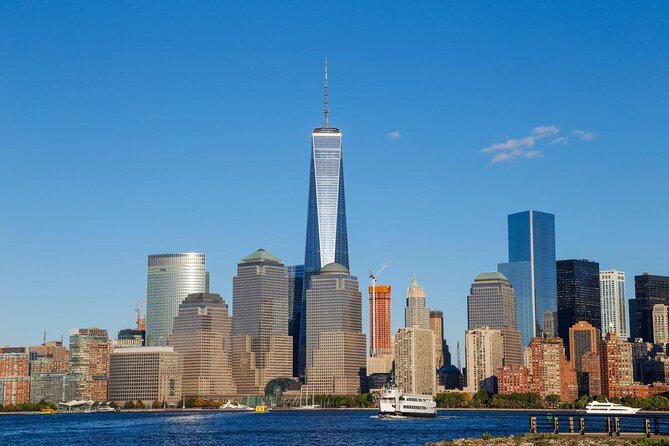
The next major stop is One World Trade Center, with the route then cycling toward Stone & Pearl Streets.
This segment is emotionally significant for many visitors, even if you keep it strictly “what am I seeing today.” The bike tour advantage is that it keeps the whole walkable map from splintering. You move from the waterfront/civic rhythm into the downtown redevelopment and modern skyline core without having to stitch directions together.
It’s also a great point in the tour to think about what you’ll do next. After you’ve seen both older downtown anchors and the modern skyline, you’ll have a much clearer idea of where to spend extra time later.
Municipal Building and Civic Fame on the way back
On the return trip, you bike past City Hall and the Municipal Building, ending with a look at the famous rooftop statue called Civic Fame.
This is the kind of final payoff that rewards your attention earlier. When you reach the Municipal Building and see Civic Fame, it feels like you completed the downtown loop with the civic story fully drawn in.
Also, because you’re heading back to the meeting point, you’re not stuck guessing where you are. The tour closes the loop neatly, which is helpful if you have dinner reservations afterward.
Riding tips that make this tour easier
Because the tour is about 8 miles total with moderate fitness required, a few practical choices can make your experience smoother:
- Wear shoes you’re comfortable moving in for a few hours. You’ll be off and on the bike during stops.
- Plan for downtown pace changes. Some segments will feel slower while crossing busy areas, then quicker once the route opens up.
- If you’re new to biking, tell the guide early. Small-group tours can adapt, and the better you communicate, the more confident you’ll feel.
One more tip: starting at noon means you may hit warmer conditions depending on the season. A quick drink plan helps.
Who this tour suits best
This is a strong fit if you want:
- an organized way to see major Lower Manhattan sights in one afternoon
- a small-group ride with bike + helmet provided
- an overview that helps you navigate downtown afterward
It’s also a good option for people who feel intimidated by NYC directions. A guide-led route means you’re not making constant “is this the right street?” calls.
It may be less ideal if:
- you don’t meet the 5-foot minimum height requirement
- you know you’ll struggle with moderate cycling time and distance
Should you book this Lower Manhattan Bike Tour?
If your goal is a practical, guided “downtown overview,” I’d book it. You’re paying for structure, gear, and local storytelling, and you get a compact loop that covers the bridge, waterfront, Wall Street icons, Battery Park, and the One World Trade Center area.
The decision comes down to comfort with cycling distance and the 5-foot height rule. If you’re good with that, this tour is an efficient way to get your bearings fast and enjoy Lower Manhattan as a living map—one ride at a time.
FAQ
How long is the Lower Manhattan Bike Tour?
The tour runs for about 3 hours 30 minutes.
How much does the tour cost?
It costs $98.00 per person.
Is the tour in English?
Yes, the tour is offered in English.
How many people are in the group?
The tour has a maximum of 6 travelers.
What is included in the price?
A local guide, a bike, and a helmet are included.
Are there any height requirements?
Yes. All riders must be at least 5 feet (152.4 cm) tall.
How far do you bike during the tour?
It’s listed as 8 miles.
Where does the tour start and end?
It starts in Lower Manhattan, New York, NY 10002, USA and ends back at the meeting point.
Can I cancel for a full refund?
Yes. You can cancel for a full refund if you cancel at least 24 hours in advance of the experience start time.
More Tours in New York City
- Statue of Liberty and Ellis Island Tour: All Options★ 5.0 · 13,571 reviews
- New York in One Day Guided Sightseeing Tour★ 5.0 · 13,166 reviews
- Central Park Pedicab Guided Tours★ 5.0 · 7,108 reviews
- New York City: Manhattan Helicopter Tour★ 4.7 · 7,076 reviews
- Private Central Park Pedicab Tour★ 5.0 · 6,981 reviews
More Tour Reviews in New York City
- NYC: SUMMIT One Vanderbilt Tickets★ 4.7 · 51,195 reviews
- NYC: Empire State Building Tickets – Observatory & Museum★ 4.7 · 25,757 reviews
- New York City: Statue of Liberty & Ellis Island with Ferry★ 4.6 · 18,683 reviews
- New York City: American Museum of Natural History Ticket★ 4.5 · 15,447 reviews
- Statue of Liberty and Ellis Island Tour: All Options★ 5.0 · 13,571 reviews
On Two Wheels Through New York City
- NYC: Central Park Bike Rentals★ 4.2 · 2,528 reviews
- NYC: Central Park Bike Rental★ 4.1 · 1,651 reviews
- Central Park Bike Rental★ 4.7 · 1,509 reviews
- New York City: Highlights of Central Park Bike or eBike Tour★ 4.6 · 800 reviews
- Central Park Bike Rental New York City★ 4.0 · 560 reviews
Just in: the newest New York City reviews on our desk





NYC Bike Tours, compared.
 ★ 4.2Central Park Bike RentalsFrom $92,528 reviews
 ★ 4.1Central Park Bike RentalFrom $81,651 reviews
 ★ 4.7Central Park Bike RentalFrom $91,509 reviews
 ★ 4.6Highlights of Central Park Bike or eBike TourFrom $47800 reviews
 ★ 4.0Central Park Bike Rental New York CityFrom $6560 reviews
 ★ 4.5Guided Bike Tour of Central Park New York CityFrom $44537 reviews
 ★ 4.5Central Park NYC Highlights Small-Group Bike TourFrom $45425 reviews
 ★ 4.5Central Park Guided Bike TourFrom $44355 reviews
Browse the lists this tour appears in