
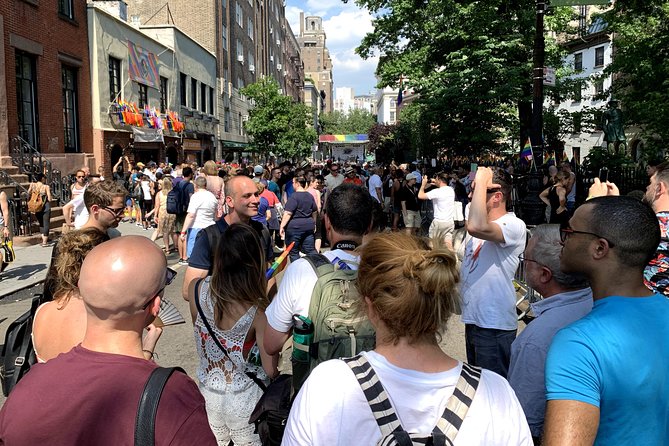
Reviewed · NYC WALKING TOURS
Pride Tours NYC’s LGBTQ Historical Walking Tour
NYC turns pride history into a quick walk, tracing Stonewall’s ripple across the Village.
I like that the story stays focused on real corners and buildings you can still see today, not just a museum lecture. You’ll move through a tight loop that links the lead-up to Stonewall, the uprising itself, and what came next.
Two things I really liked: the small group size (up to 15) keeps the pace relaxed, and you get plenty of chances to ask questions as you go. The guide also has time to point out the neighborhood in a way that makes the history easier to hold onto.
One possible drawback: the tour is offered in English, and it moves as a walking talk. If your English is still shaky, you may need to concentrate harder than you would on a slower, more stop-and-read experience.
In This Review
- Key things worth knowing before you go
- Why a 75-minute Pride Historical Walk actually works
- Price and group size: $30 for a focused, human-scale route
- Christopher Park: the pre-Stonewall setup you’ll be glad you got
- Stonewall Inn: June 28, 1969 and what happened right after
- Oscar Wilde Memorial Bookshop site to Greenwich Letterpress: Craig Rodwell’s bridge
- Gay Street sign to Axis Theatre Company: symbols, marches, and the Rainbow Flag
- Julius’ and Marie’s Crisis Café: where social life turned into action
- Gay Liberation Monument: rights and politics after Stonewall
- What to expect on the walk (and how to make it easier)
- Who this tour is best for
- Should you book Pride Tours NYC?
- FAQ
- How long is Pride Tours NYC’s LGBTQ Historical Walking Tour?
- Where does the tour start, and does it end nearby?
- Is there an admission fee for the stops?
- How big is the group?
- What language is the tour offered in?
- What if the weather is bad?
- Can I get a full refund if I cancel?
Key things worth knowing before you go
- Christopher Park start: you get the larger USA and NYC LGBTQ context right away, before you reach Stonewall.
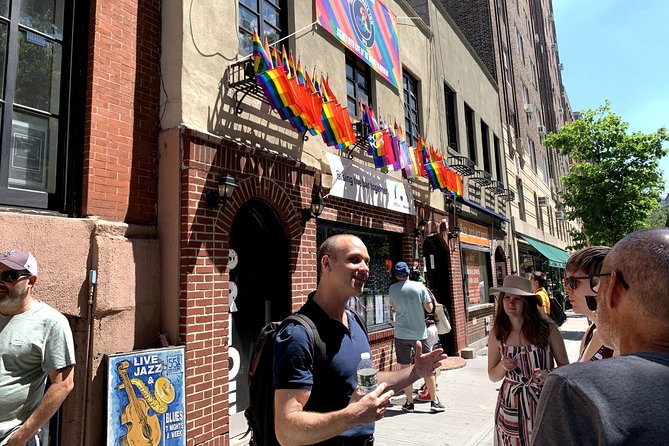
- Stonewall Inn focus: the June 28, 1969 narrative is the center of the route, followed by what happened in the immediate days.
- Craig Rodwell and Oscar Wilde Memorial Bookshop: Greenwich Letterpress ties the moment after Stonewall to the modern Pride movement.
- First Pride March + Rainbow Flag: Axis Theatre Company is where the story of early Pride and the flag’s history gets grounded in place.
- A compact route: you’ll mostly stay in a small area, which is great in heat, but it’s not a long “see the whole city” walk.
- Small-group Q&A style: the guide keeps questions flowing, so you’re not stuck watching from the sidelines.
New York City at street level, a few more walks
- SoHo, Little Italy, and Chinatown Walking Tour in New York
★ 5.0 · 3,153 reviews - Secrets of Grand Central Station Walking Tour New York City
★ 5.0 · 1,796 reviews - Greenwich Village Walking and Food Tasting Tour
★ 5.0 · 1,572 reviews - Artistic, Alternative Greenwich Village Walking Tour
★ 5.0 · 971 reviews
Why a 75-minute Pride Historical Walk actually works
If you only have a slice of time in New York, this is a strong way to spend it. The loop is short enough to feel doable, but it covers enough ground—emotionally and historically—that you leave with a clearer picture than you can get by wandering alone.
What makes this format smart is the connection between locations and moments. You’re not just learning dates. You’re seeing where people stood, planned, gathered, and fought. That turns the Stonewall era from a headline into a neighborhood story.
Price and group size: $30 for a focused, human-scale route
At $30 per person for about 1 hour 15 minutes, you’re paying for guide-led storytelling plus the convenience of a ready-made route. You’re not paying for entry fees along the way—every listed stop is ticket free—so most of the value is in interpretation and pacing.
The group cap at 15 travelers matters more than it sounds. With a smaller crowd, the guide can actually read the room—checking whether you’re keeping up, answering questions, and adjusting flow when people want detail.
Christopher Park: the pre-Stonewall setup you’ll be glad you got
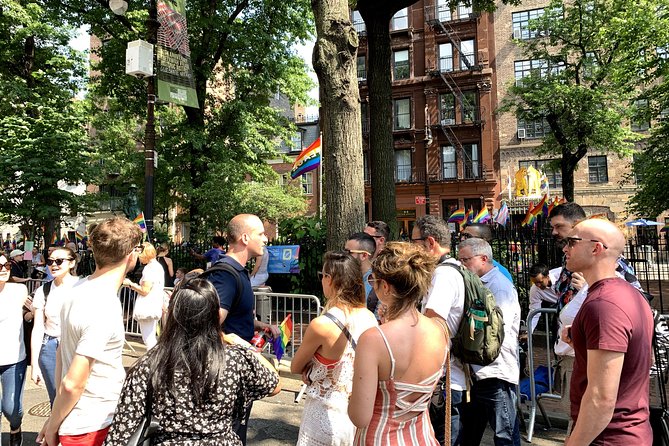
You meet at Christopher Park at 38–64 Christopher St, and the tour begins with broad context. The guide narrates an overview of LGBTQ history in the USA and New York City leading up to the Stonewall Uprising.
Why this start is useful: Stonewall was a trigger, not a first cause. If you understand what led to that moment—especially in New York—you’ll read the rest of the route with more meaning. It also helps you avoid the common feeling of watching history happen in front of you while missing why it happened.
The stop is brief (about 12 minutes), but it sets the tone. It’s also a practical way to get oriented in the area before you move toward the most famous location.
New York City on foot, a few more routes

Stonewall Inn: June 28, 1969 and what happened right after
From there, you head to the Stonewall Inn. This is where the tour focuses tightly on the early morning hours of June 28, 1969, and then moves into the immediate days that followed.
The payoff here is narrative momentum. The guide doesn’t just point and say Stonewall happened. The storytelling is built to carry you from the uprising itself into its aftermath—so the rest of the Pride story feels connected, not tacked on.
This stop lasts about 12 minutes, and it’s free of admission requirements. The timing and length keep it from turning into a slow, line-style stop. You’re there long enough to absorb the moment, then you move on while the story is fresh.
Oscar Wilde Memorial Bookshop site to Greenwich Letterpress: Craig Rodwell’s bridge
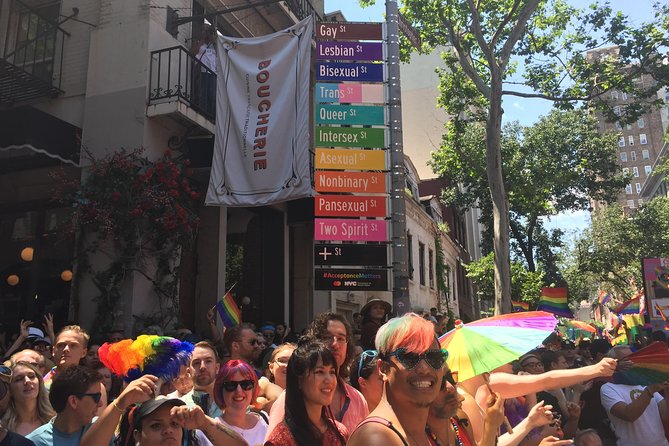
Next up is the site tied to Oscar Wilde Memorial Bookshop, now associated with Greenwich Letterpress. The guide explains the bookshop’s history, its founder Craig Rodwell, and Craig’s role in bridging the post-Stonewall energy to the modern LGBTQ Pride movement.
This part is especially valuable because it fills in the “what happened next” gap. Many people remember the uprising and then jump straight to Pride as we see it now. Here, you get the through-line: how organizing, culture, and community support evolved from that turning point.
The stop is short (about 7 minutes), but it’s dense with meaning. You’ll likely start noticing how Pride isn’t only an annual event—it’s also activism, community spaces, and people building momentum.
Gay Street sign to Axis Theatre Company: symbols, marches, and the Rainbow Flag
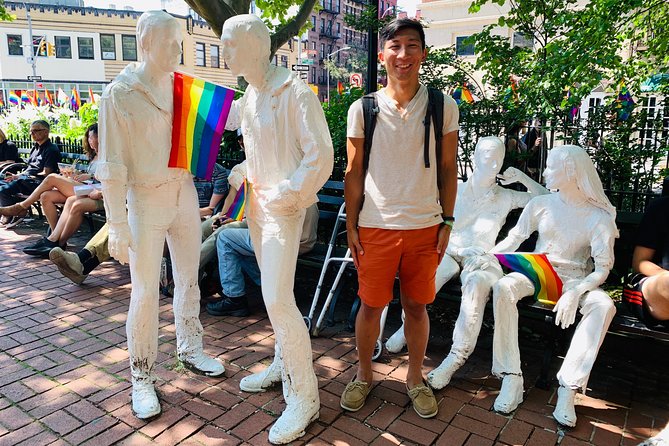
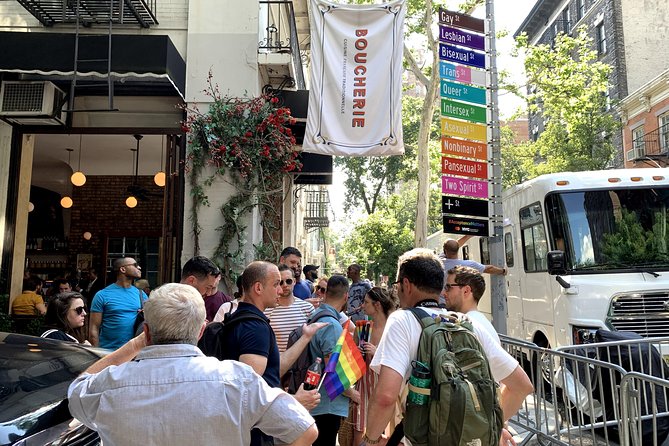
At the Gay Street sign, the guide narrates the history of the sign itself. It’s a small stop, but it’s a reminder that visibility didn’t happen by accident. Signs, streets, and public markers are part of how communities claim space.
Then you move to Axis Theatre Company, at the site of the start of the first Pride March. The guide covers the story of the first Pride March and how Pride marches have evolved since, and also explains the history of the Rainbow Flag at this location.
This is a lot for about 12 minutes, but it lands because the route keeps you in the right geography. You’re not hearing about the Rainbow Flag as a generic symbol. You’re hearing it where it became part of the local story.
Julius’ and Marie’s Crisis Café: where social life turned into action
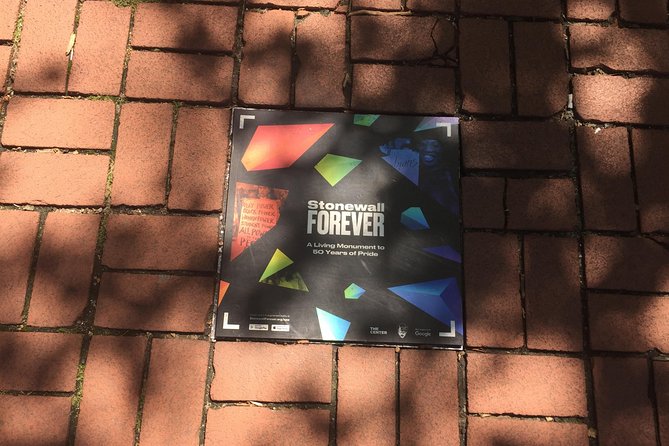
The tour continues to Julius Bar, where the guide narrates the account of the first Sip In. Then you’ll stop at Marie’s Crisis Café, with a story about the venue’s history and how the LGBTQ movement changed as it went more mainstream.
These stops do something important: they shift the focus from big protests to the smaller, daily courage that helped push change forward. A sip-in sounds simple until you remember what it meant to challenge norms in public.
Both stops are brief (about 7 minutes each), but the effect can be strong because the narration shows how tactics and public visibility changed over time. You start seeing Pride less as a single event and more as a chain reaction across different kinds of spaces.
Gay Liberation Monument: rights and politics after Stonewall
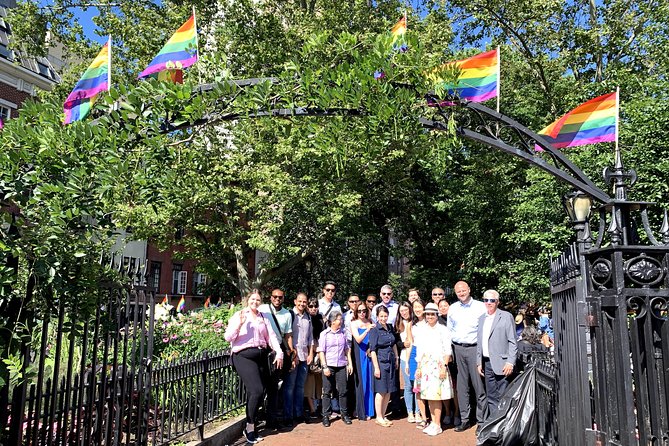
Your final stop is the Gay Liberation Monument. Here, the guide narrates the history of LGBTQ rights and politics in the USA since the Stonewall Uprising, along with the monument’s own story.
This ending works well because it gives you closure without making the history feel finished. You’ll leave with a clearer sense of how the movement’s goals and strategies evolved—especially as legal and political battles came to the forefront.
The stop runs about 12 minutes, and the tour ends back at the meeting point at Christopher Park.
What to expect on the walk (and how to make it easier)
This is a walking tour, but the route is compact. You’re not crossing half the city. Instead, you’re moving through a tight cluster of historically linked points, often in only a couple of blocks. That’s great for hot days, and it makes it easier to focus on the story without your legs fighting you.
Here are a few practical tips I’d follow:
- Wear comfortable shoes. Even a short loop can feel long if you’re rushing.
- Plan to stay present. The tour is packed with names, dates, and place-specific stories, so it helps to concentrate early rather than trying to catch up later.
- Bring your questions. The guide structure is built for Q&A, and that’s where a lot of the personal connection happens.
- If you’re learning English: aim to follow the guide’s flow first, then ask questions if something is unclear. One of the tradeoffs here is that it’s not a slow, read-every-plaque style tour.
Also, guides can vary in delivery, and one thing I’d watch for is pace. The overall format is meant to move, but if your group is slower or more talkative, you’ll want to nudge the guide—politely—toward your preferred speed.
Who this tour is best for
This Pride Historical Walking Tour is ideal if:
- You want a focused, high-signal introduction to LGBTQ+ history in New York City.
- You’re visiting the Village and want the area to mean something beyond restaurants and streets.
- You like learning by walking—seeing buildings and street markers while a guide explains why they matter.
- You want a small-group experience where questions feel normal, not awkward.
It’s also a good choice if you’re a returning New Yorker type who thinks you know the neighborhood. Even when you’ve passed these sites before, the connected story can change how you see them.
Should you book Pride Tours NYC?
Yes—if you want a short, story-led Pride route that connects the dots from pre-Stonewall context to the uprising and then onward to Pride symbols and political change. The $30 price makes sense because you’re paying for guided interpretation, and the stops don’t require paid entry.
Skip it only if you’re looking for a longer, museum-style timeline or a tour that covers lots of far-flung neighborhoods. This one is intentionally tight: you’re here for depth within a small area, not for “covering NYC.”
FAQ
How long is Pride Tours NYC’s LGBTQ Historical Walking Tour?
It runs about 1 hour 15 minutes.
Where does the tour start, and does it end nearby?
You start at Christopher Park (38–64 Christopher St, New York, NY 10014) and the tour ends back at the meeting point.
Is there an admission fee for the stops?
No. The listed stops all show admission tickets as free.
How big is the group?
The tour has a maximum of 15 travelers.
What language is the tour offered in?
The tour is offered in English.
What if the weather is bad?
This experience requires good weather. If it’s canceled due to poor weather, you’ll be offered a different date or a full refund.
Can I get a full refund if I cancel?
Free cancellation is available. You can cancel up to 24 hours in advance for a full refund; canceling less than 24 hours before the start time isn’t refunded.
More Tours in New York City
- Statue of Liberty and Ellis Island Tour: All Options★ 5.0 · 13,571 reviews
- New York in One Day Guided Sightseeing Tour★ 5.0 · 13,166 reviews
- Central Park Pedicab Guided Tours★ 5.0 · 7,108 reviews
- New York City: Manhattan Helicopter Tour★ 4.7 · 7,076 reviews
- Private Central Park Pedicab Tour★ 5.0 · 6,981 reviews
More Tour Reviews in New York City
- NYC: SUMMIT One Vanderbilt Tickets★ 4.7 · 51,195 reviews
- NYC: Empire State Building Tickets – Observatory & Museum★ 4.7 · 25,757 reviews
- New York City: Statue of Liberty & Ellis Island with Ferry★ 4.6 · 18,683 reviews
- New York City: American Museum of Natural History Ticket★ 4.5 · 15,447 reviews
- Statue of Liberty and Ellis Island Tour: All Options★ 5.0 · 13,571 reviews
New York City, One Block at a Time
- SoHo, Little Italy, and Chinatown Walking Tour in New York★ 5.0 · 3,153 reviews
- Secrets of Grand Central Station Walking Tour New York City★ 5.0 · 1,796 reviews
- Greenwich Village Walking and Food Tasting Tour★ 5.0 · 1,572 reviews
- Artistic, Alternative Greenwich Village Walking Tour★ 5.0 · 971 reviews
- Brooklyn Bridge & DUMBO Neighborhood Tour – from Manhattan to Brooklyn★ 5.0 · 826 reviews
Just in: the newest New York City reviews on our desk





NYC Walking Tours, compared.
 ★ 5.0SoHo, Little Italy, and Chinatown Walking Tour in New YorkFrom $393,153 reviews
 ★ 5.0Secrets of Grand Central Station Walking Tour New York CityFrom $391,796 reviews
 ★ 5.0Greenwich Village Walking and Food Tasting TourFrom $941,572 reviews
 ★ 5.0Artistic, Alternative Greenwich Village Walking TourFrom $39971 reviews
 ★ 5.0Brooklyn Bridge & DUMBO Neighborhood Tour – from Manhattan to BrooklynFrom $49826 reviews
 ★ 5.0Central Park Guided Walking TourFrom $44774 reviews
 ★ 4.6Private Walking Tour with a LocalFrom $55771 reviews
 ★ 5.0NYC Lower East Side Walking and Food TourFrom $94646 reviews
Browse the lists this tour appears in