

Reviewed · NYC OBSERVATION DECKS
Secrets of Hudson Yards and the Edge: A walking tour
Hudson Yards is all angles and attitude. This walking tour pulls back the glossy curtain with real stories behind the towers, plus iconic stops like The Vessel and The Edge. I especially like how it mixes urban design talk with human stories, and I like that it ends at a food hall with serious chef power. The main drawback is time: the whole thing can feel closer to about an hour than a full-long outing.
You’ll also get a non-corporate lens on New York’s newest megadevelopment, including future plans and the questions money never answers out loud. If you want pure photo spots with zero context, this probably isn’t your match. But if you enjoy walking, listening, and leaving with sharper city instincts, it’s a fun way to spend an hour or so in Midtown.
In This Review
- Key moments worth your attention
- Starting at 30 Hudson Yards: where the tour kicks off
- Hudson Yards’ shiny vision—and the darker stories behind it
- Secret passageways and quick stops that make the neighborhood feel real
- Dancing skyscrapers and the engineering story you won’t get from a postcard
- The Vessel: more than a photo stop
- The Edge observation deck: finding out what floor it’s really on
- A giant performance space on wheels—and why that matters in a neighborhood this polished
- The 1,000-foot vine concept and the plant-covered skyscraper moment
- Feminist fight, a park named after her, and the public-art angle
- The future of Hudson Yards: where the money story fits in
- Ending at Mercado Little Spain: chefs José Andrés and the Adría brothers
- Price and value: is $40 a fair deal for this walk?
- Who this tour is best for (and who should skip it)
- Should you book Secrets of Hudson Yards and the Edge?
- FAQ
- FAQ
- Where does the tour start?
- How much does the tour cost?
- How long is the tour?
- What language is the tour guide?
- Is the tour wheelchair accessible?
- What is the tour’s end location?
Key moments worth your attention

- 30 Hudson Yards start point: You begin right at the edge of the development, not some distant landmark.
- Secrets in short detours: Expect quick “secret stops” that add surprise without dragging your day.
- Stories behind the skyline: You’ll hear about deception, disappointment, and death tied to the gleaming buildings.
- The Vessel plus The Edge: You’ll connect the two biggest icons of the area to the thinking behind them.
- A plant-covered skyscraper story: You’ll see the building described with a 1,000-foot-tall vine concept.
- Ending at Mercado Little Spain: You finish in a place tied to José Andrés and the Adría brothers—food as a payoff.
Higher still: other New York City observation decks
- NYC: SUMMIT One Vanderbilt Tickets
★ 4.7 · 51,195 reviews - New York Explorer Pass: Top Attractions including Edge
★ 4.6 · 7,872 reviews - NYC Empire State Building Observation Deck Ticket
★ 4.5 · 6,916 reviews - SUMMIT One Vanderbilt Experience Ticket
★ 4.5 · 5,398 reviews
Starting at 30 Hudson Yards: where the tour kicks off

The tour begins outside the office entrance to 30 Hudson Yards, at the corner of W 33rd Street and Hudson Blvd East. That matters more than it sounds. Hudson Yards is big, spread out, and built for movement. Starting in the right spot helps you get your bearings fast, so you don’t spend your first minutes figuring out which way everything points.
Right away, the tone is set: this isn’t a “pose and move on” walk. It’s framed as an edgy look at what’s behind the marketing—so you’re primed to notice details like public spaces, sightlines, and how the neighborhood is stitched together for people who plan their days by reservation.
If you’re someone who likes walking tours where the guide keeps the story moving, you’ll probably appreciate the structure. Several stops are short on purpose, which keeps momentum up.
Hudson Yards’ shiny vision—and the darker stories behind it
Early on, you get a guided overview of Hudson Yards as the newest neighborhood in NYC. The key idea: you’re not just looking at buildings; you’re looking at a giant real estate story with winners, losers, and long-term bets.
One of the most intriguing parts is the focus on the uncomfortable side: the tour promises stories of deception, disappointment, and death connected to the towers. That doesn’t mean the walk turns grim the whole time. Instead, it adds weight to what you’re seeing. When you stand in front of a gleaming complex, you’ll know the city has paperwork, politics, and human consequences behind the façade.
You’ll also hear about the neighborhood’s history and where it’s heading. A big theme is future planning, including whether there’s a plan to make Hudson Yards the Las Vegas of Manhattan. That line alone tells you the tour is interested in ambition—how developers and designers sell a lifestyle, not just an address.
One practical consideration: Hudson Yards is visually loud. If you’re easily overwhelmed by crowds, chrome, and constant construction, go in with a mindset to slow down and listen. The stories are the anchor.
Secret passageways and quick stops that make the neighborhood feel real
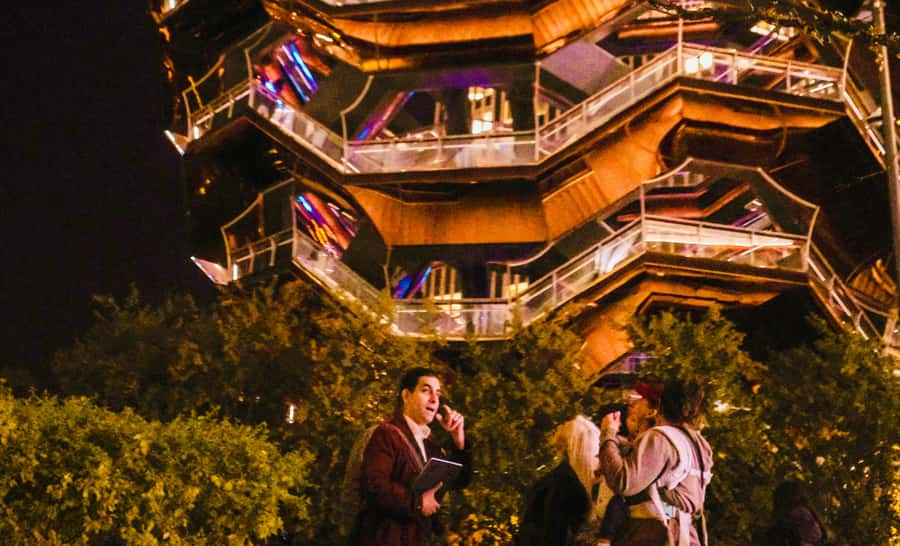
A walking tour lives or dies on what it gets you to notice. Here, you get multiple brief “secret stop” moments—short visits that break the routine and give your brain new reference points.
Even without naming every exact location, the tour’s promise is clear: you’ll look for things that don’t fit the postcard version of Hudson Yards. Think of it like this—Hudson Yards can feel like a designed space where everything is visible and controlled. These detours suggest there’s still hidden rhythm: connections, passageways, and small-scale moments you’d miss if you only wander for views.
This is also where the tour’s “non-corporate perspective” really matters. Official descriptions tend to highlight design awards and renderings. This tour is positioned to talk about why decisions were made and who those decisions serve.
If you’re a first-timer, you’ll get value simply from building mental maps. If you’ve been once, you may still find a few things you missed the first time—because the tour is not about repeating the most obvious angles.
New York City at street level, a few more walks


Dancing skyscrapers and the engineering story you won’t get from a postcard

At some point, the walk shifts from street-level vibes to higher-level thinking: dancing skyscrapers and the cutting-edge engineering behind the area.
You might be wondering: how can a skyscraper dance? The honest answer is that the tour is using a vivid phrase to make you pay attention to motion, structural behavior, and design ingenuity. You’re not just hearing a fun metaphor—you’re learning how architects and engineers built solutions that work at a massive scale.
This is a big plus for you if you like architecture but don’t want a 40-slide lecture. Hudson Yards is one of the places in NYC where engineering choices show up in the physical experience: how buildings meet, how the ground plan feels, and how public spaces are shaped around structures.
The tour also points you toward “what brought Hudson Yards to life,” tying design to technology rather than leaving it as a black box. If you’ve ever looked at a big development and thought, I want to understand the logic, this is your chance.
The Vessel: more than a photo stop
Then comes The Vessel, one of the neighborhood’s most iconic landmarks. You’ll get about ten minutes of sightseeing here, but the goal isn’t only to look. The tour also includes the real story behind the giant work of art.
That’s the important distinction. The Vessel can be a quick grab-and-go photo, or it can be something you understand. When you know why it was created and what the concept was trying to do, you start noticing how people move through it. It becomes less of a sculpture and more of a social machine—something designed to pull visitors into the same vertical pathway.
Even if you’re not obsessed with contemporary art, this stop can still land. The structure is visually unforgettable. And learning the backstory gives you a reason to care beyond the aesthetics.
If you’re visiting on a busy day, plan for lines or crowding. The Vessel is famous, so your best experience comes from being patient and letting the design story do the work for you.
The Edge observation deck: finding out what floor it’s really on
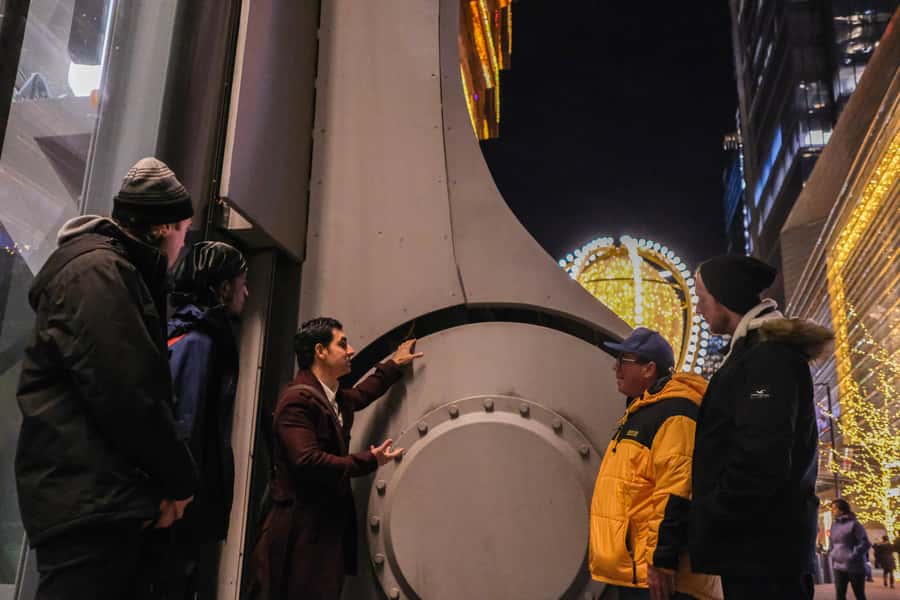
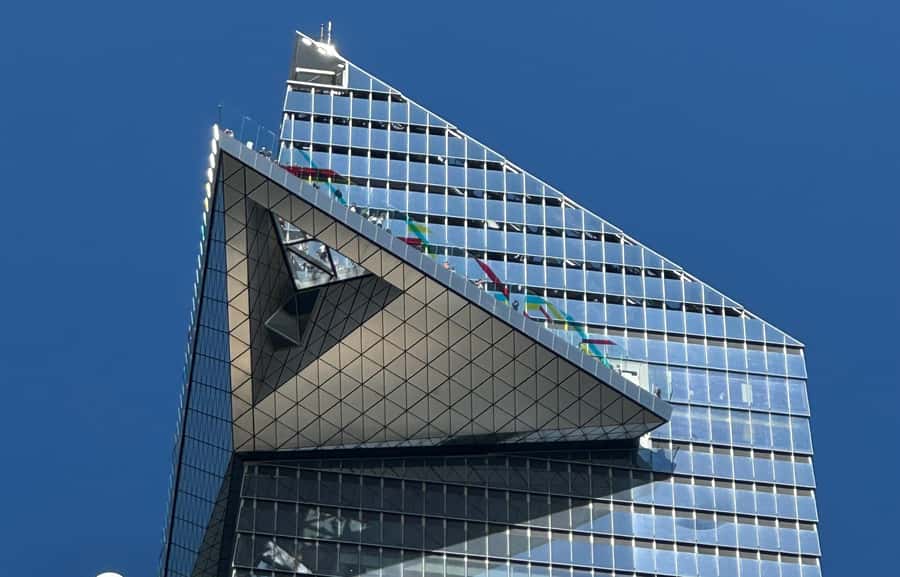
One highlight is straightforward: you’ll learn what floor The Edge observation deck is really on. That kind of detail is exactly what I like in a tour because it’s the difference between knowing a landmark exists and actually understanding it in context.
Observation decks are often wrapped in marketing language. This tour cuts through that by making you learn the practical truth behind the experience. It’s also useful because it helps you picture the height and the design intent while you’re still on the ground.
If you’re the type who wants to plan your day precisely—when to go, what to expect, and how to make the most of limited time—this is a helpful tidbit. You’ll also understand the area’s skyline logic better after hearing how The Edge fits into Hudson Yards’ overall identity.
A giant performance space on wheels—and why that matters in a neighborhood this polished

The tour includes a stop or feature described as a giant performance space on massive wheels. Even without turning it into a technical breakdown, the concept is cool because it hints that Hudson Yards isn’t only about permanent monuments. It’s built to host changing events.
That’s a practical insight for you. When a place is designed to be flexible, the “story” of the neighborhood isn’t frozen. It can pivot based on programming, crowds, and marketing. A performance space designed around wheels is basically a reminder that the city experience here is meant to be adjustable.
You also get a sense of how public space is being engineered. Hudson Yards can feel like a campus of impressive objects. This kind of feature pushes it toward being an active venue, not just a skyline display.
If you’re the sort of traveler who likes places that feel alive, this element is worth paying attention to. Even if you don’t catch a performance, the idea changes how you read the area.
The 1,000-foot vine concept and the plant-covered skyscraper moment
One of the most memorable descriptions on this tour is a plant-covered skyscraper with a concept of a 1,000-foot-tall vine. That’s the kind of detail you can’t fully absorb from a distance. On a walk, you can register scale, the texture of the structure, and the intention behind the green look.
More importantly, it gives you something to think about beyond “pretty building.” Green design claims are one of the easiest things for big developments to use as branding. Hearing about this feature as part of the neighborhood’s larger story helps you see it as a design statement—maybe sincere, maybe strategic, but definitely part of how the neighborhood wants to be perceived.
This is where a walking tour beats a photo stop. You get time to connect the visual to the message.
Feminist fight, a park named after her, and the public-art angle

The tour doesn’t ignore people. It includes a story about a fierce feminist who fought for the poor of America, and notes that a Hudson Yards park is named for her. Even if you don’t know the figure going in, the tour is nudging you to link place to values, not just place to luxury.
It also points out public art designed by well-known revolutionary artists. That matters because Hudson Yards isn’t only new architecture. It’s also a designed cultural space. If you like the intersection of art, politics, and city planning, you’ll probably enjoy how the tour connects those dots instead of treating art as decoration.
The future of Hudson Yards: where the money story fits in
A theme you’ll hear repeatedly is money: where the money for Hudson Yards came from, plus how the neighborhood’s future plans are being shaped.
That’s valuable for you because big developments often get discussed as if they appeared out of thin air. In reality, they’re funded, staged, and timed. Learning where money came from—and what it’s trying to accomplish—adds clarity to what you see today.
The tour also frames questions like whether this will become a new version of Las Vegas of Manhattan. That’s a cultural prediction. It tells you Hudson Yards wants to be more than offices and housing. It wants nightlife energy, spectacle, and repeat visits.
When you walk with that in mind, you start noticing which spaces feel designed for lingering and which feel designed for passing through.
Ending at Mercado Little Spain: chefs José Andrés and the Adría brothers
The walk finishes at Mercado Little Spain. This ending is smart. Instead of stopping right after the landmarks, you end in a place where you can reset and eat.
The tour includes the story of Mercado Little Spain’s restaurants, founded by Spanish chefs José Andrés, Ferran Adría, and Albert Adría. That lineup is one of the reasons this finish feels like more than a random food stop.
You also learn about José Andrés providing fresh meals during humanitarian crises around the world. That part lands because it shifts the conversation from restaurant branding to real-world impact—how celebrity and food can connect to action.
Practical takeaway: if you’re going to Hudson Yards anyway, plan to stay long enough to eat here. It’s a satisfying payoff after a tour that mixes spectacle with story.
Price and value: is $40 a fair deal for this walk?
At $40 per person for a tour listed as 1 day, you should think about value in terms of what you get: a guided story walk, multiple landmark stops, and a focus on context rather than just photos.
If you normally pay for architecture walking tours, $40 is in the reasonable range—especially because you’re not only seeing The Vessel and The Edge area. You’re also hearing about planning, money, and the neighborhood’s planned future. That’s the stuff that makes the day stick in your memory.
The one possible value snag is duration. One account notes it felt too short, clocking in around one hour. If you’re the type who wants a long sit-down-and-stroll experience, you might wish you had more time. But if you want a focused story walk with major hits, the length can actually be a plus.
Who this tour is best for (and who should skip it)
This tour is a strong fit if you like:
- skyline landmarks but also want context
- architecture and city planning stories that stay human
- quick detours that keep you from wandering aimlessly in a big new district
- finishing with food tied to real chef reputations
You may want to skip it if:
- you only care about the most famous photo angles and don’t want “why this exists” explanations
- you need a longer, more relaxed time block than about an hour
- you get impatient with city walks that move you between several short stops
Should you book Secrets of Hudson Yards and the Edge?
I’d book it if you’re curious about how Hudson Yards works as a designed world—how it sells itself, what it hides, and why the neighborhood looks the way it does. The best part is the mix: The Vessel and The Edge for wow, plus stories about money, planning, and consequences for substance.
If you’re strictly chasing a long day of sightseeing, you might feel it’s light. But if you want an efficient, story-driven walk through NYC’s newest showpiece area—and you like closing the loop with a serious meal—this is a solid buy.
FAQ
FAQ
Where does the tour start?
It starts outside the office entrance to 30 Hudson Yards, at the corner of W 33rd Street and Hudson Blvd East.
How much does the tour cost?
The price is listed as $40 per person.
How long is the tour?
The duration is listed as 1 day, with starting times available. One account notes it felt closer to about an hour.
What language is the tour guide?
The live tour guide is English.
Is the tour wheelchair accessible?
Yes, the tour is wheelchair accessible.
What is the tour’s end location?
It finishes at Mercado Little Spain.
More Tour Reviews in New York City
- NYC: SUMMIT One Vanderbilt Tickets★ 4.7 · 51,195 reviews
- NYC: Empire State Building Tickets – Observatory & Museum★ 4.7 · 25,757 reviews
- New York City: Statue of Liberty & Ellis Island with Ferry★ 4.6 · 18,683 reviews
- New York City: American Museum of Natural History Ticket★ 4.5 · 15,447 reviews
- Statue of Liberty and Ellis Island Tour: All Options★ 5.0 · 13,571 reviews
New York City, One Block at a Time
- SoHo, Little Italy, and Chinatown Walking Tour in New York★ 5.0 · 3,153 reviews
- Secrets of Grand Central Station Walking Tour New York City★ 5.0 · 1,796 reviews
- Greenwich Village Walking and Food Tasting Tour★ 5.0 · 1,572 reviews
- Artistic, Alternative Greenwich Village Walking Tour★ 5.0 · 971 reviews
- Brooklyn Bridge & DUMBO Neighborhood Tour – from Manhattan to Brooklyn★ 5.0 · 826 reviews
Best Views in New York City: More Decks
- NYC: SUMMIT One Vanderbilt Tickets★ 4.7 · 51,195 reviews
- New York Explorer Pass: Top Attractions including Edge★ 4.6 · 7,872 reviews
- NYC Empire State Building Observation Deck Ticket★ 4.5 · 6,916 reviews
- SUMMIT One Vanderbilt Experience Ticket★ 4.5 · 5,398 reviews
- Top of the Rock Observation Deck New York City Ticket★ 4.5 · 4,556 reviews
Just in: the newest New York City reviews on our desk





NYC Observation Decks, compared.
 ★ 4.7SUMMIT One Vanderbilt TicketsFrom $4751,195 reviews
 ★ 4.6New York Explorer Pass: Top Attractions including EdgeFrom $847,872 reviews
 ★ 4.5NYC Empire State Building Observation Deck TicketFrom $476,916 reviews
 ★ 4.5SUMMIT One Vanderbilt Experience TicketFrom $475,398 reviews
 ★ 4.5Top of the Rock Observation Deck New York City TicketFrom $624,556 reviews
 ★ 4.6New York Pass®: 100+ Attractions including Edge NYCFrom $1522,465 reviews
 ★ 4.0NYC Edge Observation Deck at Hudson Yards Admission TicketFrom $392,242 reviews
 ★ 4.0Go City: New York Explorer Pass: 100+ Things to Do Including EdgeFrom $891,895 reviews
Browse the lists this tour appears in