
Reviewed · 9/11 MEMORIAL & GROUND ZERO TOURS
Lower Manhattan & 9/11 Memorial Exclusive Guided Walking Tour
Lower Manhattan tells two stories at once. This 2.5-hour guided walking tour strings together major landmarks—first the harbor-and-immigration side, then Wall Street and the 9/11 Memorial—so you don’t spend your day guessing where to go. I like the way it’s paced for first-timers, and I also appreciate the private feel that keeps the experience flexible instead of feeling like a cattle line.
Two things really make it click for me: you get the money-and-architecture highlights of Lower Manhattan on foot, and you still get time to slow down for remembrance. In one 5-star review, a guide named Robin was praised for keeping the story engaging across a wide age range, from a 9-year-old to people in their 20s.
One possible drawback: some stops are exterior-only or admission not included, and a few sights may require you to handle entry plans separately (especially around the 9/11 Memorial complex). Also, security rules can limit access inside certain venues, so plan on walking, looking, and learning more than touring interiors.
In This Review
- Key things to know before you go
- A smart way to see Lower Manhattan without losing your bearings
- From Castle Clinton to the harbor: where newcomers first landed
- SeaGlass Carousel and Hurricane Sandy recovery
- Bowling Green: oldest park, older stories, and the right-size setting
- Trinity Church and Wall Street: history on the move
- The NYSE exterior, Fearless Girl, and the architecture around money
- St. Paul’s Chapel to Zuccotti Park: two different kinds of sacred space
- One World Trade Center and the 9/11 Memorial pools: how to get more out of your visit
- Price, value, and why $51.94 can be a good deal
- Timing, route changes, and what to bring for a smoother walk
- Who should book this private Lower Manhattan & 9/11 Memorial walk
- Should you book this Lower Manhattan & 9/11 Memorial tour?
- FAQ
- Where does the tour start and end?
- What time does the tour begin?
- Is this a private tour?
- How many people are allowed per tour?
- What’s included in the price?
- Do I need to buy tickets for the stops?
- Is hotel pickup provided?
- What language is the tour offered in?
- What should I wear or bring?
- What is the cancellation policy?
Key things to know before you go
- Private group up to 12: only your group participates, with a dedicated professional guide.
- Battery Park to One World Trade Center: you’ll finish near 285 Fulton St, so plan how you’ll get home afterward.
- Most sights are quick stops: think about ~10 minutes at each landmark to cover ground without rushing the key moments.
- Admission isn’t always included: NYSE, One World Trade Center, and the 9/11 Memorial & Museum entry aren’t included.
- Runs rain or shine: the route is designed for weather, but you should still pack for wind, heat, and sudden showers.
- No large bags/suitcases: it’s a security-sensitive area, so travel light.
More ways to visit Ground Zero and the memorial
- NYC: One World Observatory Skip-the-Line Ticket
★ 4.7 · 12,329 reviews - 9/11 Memorial, Ground Zero Tour with Optional 9/11 Museum Ticket
★ 5.0 · 6,381 reviews - 9/11 Memorial Museum Admission Ticket
★ 4.5 · 6,376 reviews - All-Access 9/11: Ground Zero Tour, Memorial and Museum, One World Observatory
★ 5.0 · 4,886 reviews
A smart way to see Lower Manhattan without losing your bearings
Lower Manhattan can feel like information overload. Buildings rise, streets change names, and you’re never sure which corner is important until you’re already past it.
This tour is built to solve that problem with a simple formula: walk the key blocks, hit the recognizable icons, and tie them to plain-English stories. It’s also a good fit if you’re short on time but want more than a random self-guided stroll through Wall Street.
Because it’s a private guided walk, you can ask questions as you go. And with a cap of 12 people, it stays easy to hear your guide and keep moving at a realistic pace.
From Castle Clinton to the harbor: where newcomers first landed
You start at the Battery Park Underpass, and the first stop sets a big theme: immigration and national growth. Castle Clinton National Monument is often described as a city landmark, but it’s more than a pretty old structure—it was built between 1808 and 1811 and served as the first U.S. immigration station. The story ties directly to the fact that more than 8 million people arrived in the U.S. between 1855 and 1890, using this corridor of arrival.
A short walk later, you shift to the New York Harbor viewpoint. You’re looking at the mouth of the Hudson River, and the tour frames the harbor as one of the biggest natural harbors in the world. For me, that context matters: it explains why Lower Manhattan became a magnet for trade, finance, and global movement long before Wall Street got its nickname.
Practical tip: this early stretch works best when you’re alert. Wear shoes with grip. You’ll be standing and walking on city surfaces that can get slick.
SeaGlass Carousel and Hurricane Sandy recovery
The stop at the SeaGlass Carousel is one of the tour’s nice surprises. It’s fish-themed, and the guide explains why it exists here: it became a visible symbol of recovery after the 2012 Hurricane Sandy damage.
What I like about this kind of stop is that it prevents the day from becoming only “old history.” You see how New York rebuilds, and you learn that the design and construction took nearly a decade. That’s the kind of real timeline detail that helps the city feel alive instead of frozen in postcards.
If you’re visiting with kids, this stop often lands well because it’s visually fun while still carrying meaning.
New York City at street level, a few more walks


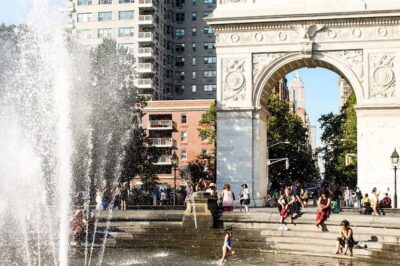
Bowling Green: oldest park, older stories, and the right-size setting
Next up is Bowling Green, New York’s oldest park. It’s small, but that’s the point—this is the kind of place where a guided explanation turns a quick stop into something you actually remember.
The tour connects Bowling Green to two separate layers of legend and early city life: it’s traditionally tied to council grounds for Native American tribes, and it’s also associated with the sale of Manhattan in 1626 to Peter Minuit.
Then comes an icon you’ll recognize immediately: the Charging Bull. The tour explains that Arturo Di Modica created it in bronze, and that it was famously placed outside the New York Stock Exchange without permission. It became an instant hit once set up at Bowling Green, and the tour positions the bull as one of those visual shorthand moments for Wall Street energy.
Practical tip: Charging Bull is popular for photos. If you want a more relaxed moment, let your guide suggest when to step aside for pictures so you’re not stuck waiting for a crowd.
Trinity Church and Wall Street: history on the move
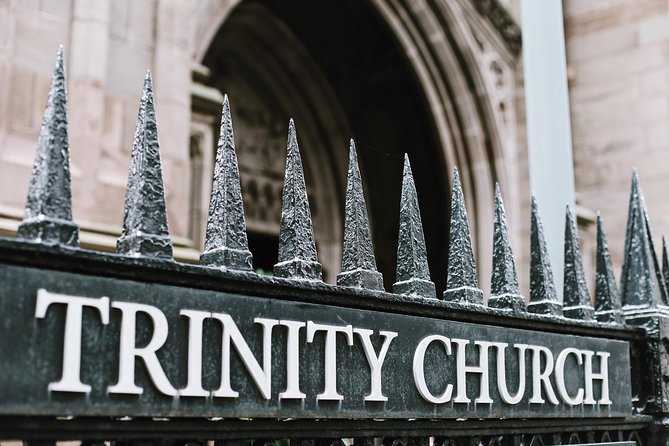
After the park, the tour turns toward Trinity Church, beginning in 1696 near the Wall Street and Broadway intersection. This stop is all about perspective: you’re in the densest modern finance zone in the U.S., and yet the guide points you to a parish churchyard that reaches back centuries.
You’ll see the graves of Mr and Ms Hamilton in the Trinity churchyard area and a monument near their resting place. This adds a human scale to Wall Street’s big buildings, and it helps the neighborhood feel less like a museum and more like a working district with deep roots.
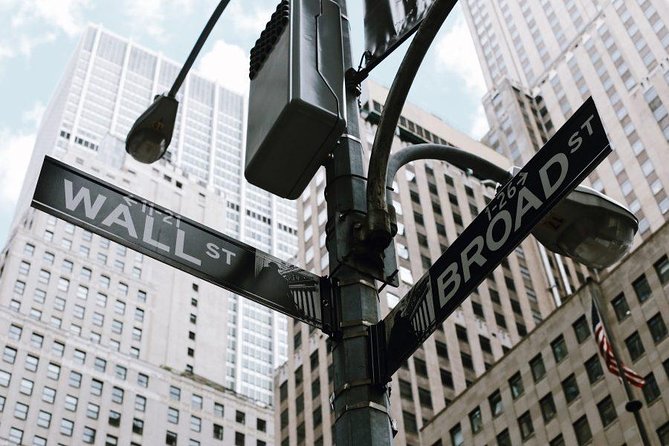
Then you walk along Wall Street, described here as the famous eight-block stretch through Lower Manhattan. Your guide connects it to the international financial system, and you start to understand why this street became global shorthand.
If you’re prone to information fatigue, this portion is a good “reset” because you’re moving. You’re not locked in place. You’re getting the street-level view.
The NYSE exterior, Fearless Girl, and the architecture around money
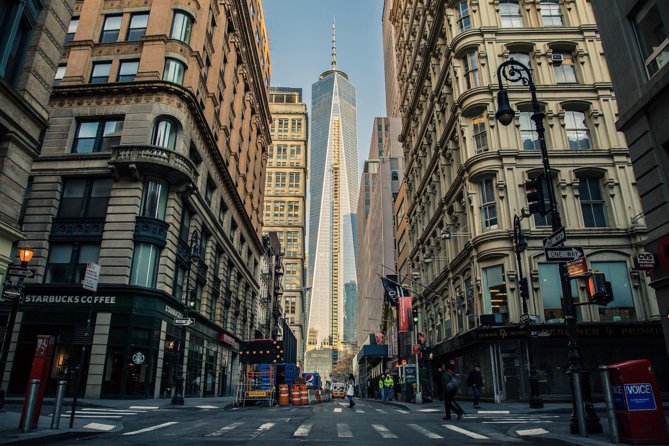
Wall Street is famous for its landmarks, but you don’t need tickets to see much of what makes it feel iconic.
The tour includes the exterior of the New York Stock Exchange, founded in 1792 and designated a National Historic Landmark. You’ll also see Fearless Girl, the bronze statue by Kristen Visbal, positioned in front of the NYSE. The guide frames it as a symbol of female empowerment, and the timing of when the statue appeared (and why it hit people so hard) is usually part of the explanation your guide shares as you stand there.
Two other architecture moments follow at street pace:
- House of Morgan: exterior only, built in 1913, classical style, and designated a New York City landmark in 1965.
- Federal Hall: a key early-American stop tied to the name given to the first of two historic buildings at 26 Wall Street. The original Greek Revival structure was completed in 1703, while the current building (completed 1842) is highlighted as one of the best examples of neoclassical architecture in New York.
What I like here is that the tour doesn’t just say “this is old.” It links architecture to what was happening politically and economically at the time. In a city full of impressive facades, that explanation makes the walking feel earned.
St. Paul’s Chapel to Zuccotti Park: two different kinds of sacred space
From Federal Hall you move to St. Paul’s Chapel, part of the Trinity Church Wall Street parish. The tour explains it as a “chapel-of-ease” for people who didn’t want to walk a few blocks to Trinity.
It also highlights that when St. Paul’s Chapel was completed in 1766, it was the tallest building in New York City. That detail is a fun way to picture the area before skyscrapers existed—suddenly the skyline story makes more sense.
Then you shift to a place tied to modern tragedy and memory: Zuccotti Park, formerly Liberty Plaza Park. The tour notes it was heavily damaged in the 9/11 attacks and went through recovery efforts. Today, the plaza becomes a site for events commemorating the anniversary of the attack.
Even if you’re not a big “park person,” this stop helps ground the day. You’re not only watching history happen—you’re seeing how it’s marked in public space.
One World Trade Center and the 9/11 Memorial pools: how to get more out of your visit
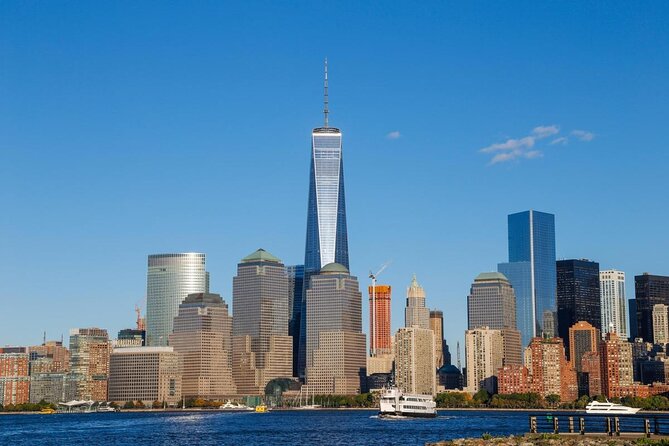
The final stretch is where the emotional weight lands. You’ll see One World Trade Center, also known as the Freedom Tower, and the tour connects it to the fact that it stands where the Twin Towers once towered over the city.
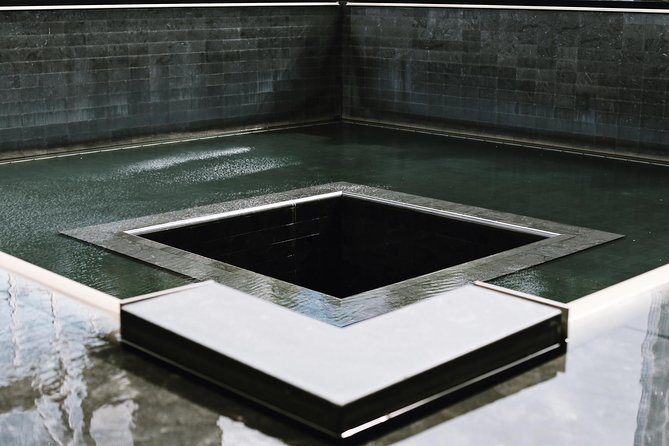
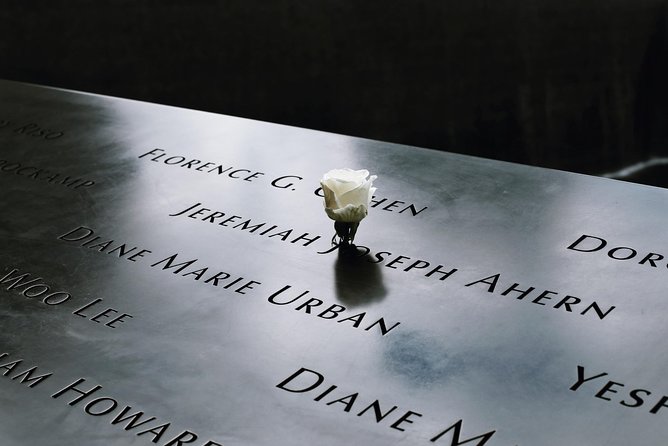
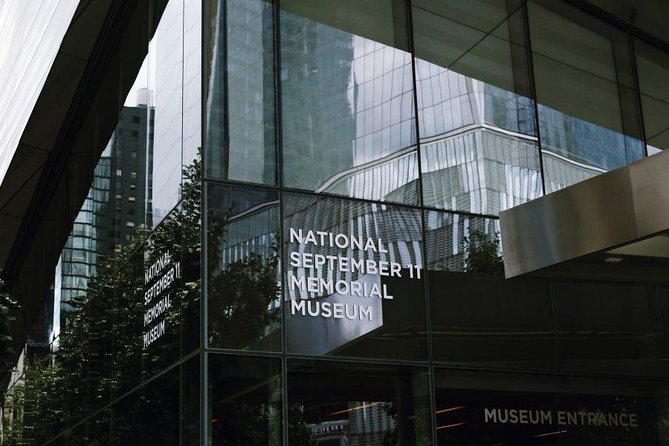
Next is The National 9/11 Memorial & Museum area, with time at the memorial itself. The guide focuses on the twin reflecting pools, described here as the largest manmade waterfalls in North America. You’ll also see the bronze panels with the names of those who died, inscribed along the edges of the pools.
A key practical note: admission to the Memorial & Museum isn’t included in the tour price. That doesn’t mean you won’t be able to see the memorial—just that you shouldn’t assume entry is packaged. Plan for security lines and possible timed-entry needs so you don’t end up scrambling at the last minute.
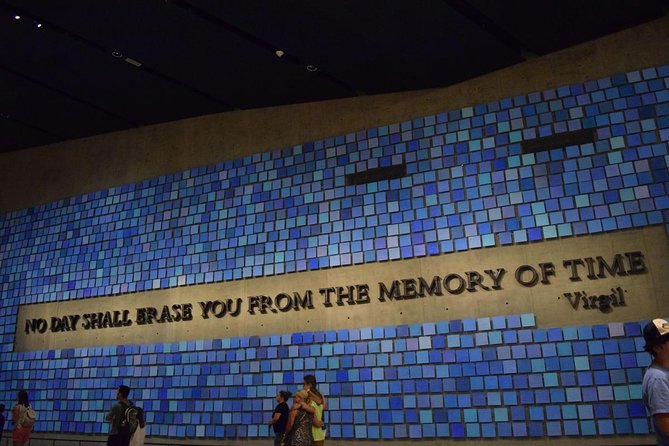
When you’re there, I suggest doing one thing: slow your eye down. Pick one name panel section and read a handful of inscriptions. The memorial is designed to hold that kind of quiet focus, and a guided tour helps you know where to direct your attention.
Price, value, and why $51.94 can be a good deal
At $51.94 per person, this is priced for travelers who want a guided, structured Lower Manhattan experience without paying for lots of separate attractions.
Here’s how the value stacks up:
- Many stops are free to view—including major icons like Castle Clinton (free), Bowling Green area highlights, Trinity Church area, and the memorial grounds perspective.
- You’re paying for a professional guide who strings together meaning. In a place like Wall Street, context is what you’re really buying.
- It’s private for your group, and that matters if you’re traveling with family or friends who have questions. Even small groups can feel calmer with a dedicated guide and a walking pace that stays realistic.
Where the cost can feel “less inclusive” is in what isn’t included: the NY Stock Exchange admission, One World Trade Center admission, and the National 9/11 Memorial & Museum admission. The tour still gives you big visual hits, but it’s not designed as an “everything paid for” ticket bundle.
Timing, route changes, and what to bring for a smoother walk
The tour starts at 2:00 pm and runs about 2 hours 30 minutes. You finish near One World Trade Center at 285 Fulton St, so your afternoon logistics matter. If you’re not familiar with the area, it’s smart to line up a ride before you set out.
You’re also told to expect security constraints: some attractions can’t be visited from inside, and that’s normal for Lower Manhattan. The tour includes a note that the route may be affected by national celebrations, with an alternative route provided so you still see the highlights. In those cases, refunds or discounts aren’t offered—so think of the itinerary as “highlights covered,” not “one exact sidewalk path.”
Bring practical stuff:
- Comfortable shoes (non-negotiable for a 2.5-hour walk)
- Water and a small umbrella if rain is possible
- A hat in warmer months
- No large bags or suitcases, since the security environment can be strict
Who should book this private Lower Manhattan & 9/11 Memorial walk
This tour is a strong match if you’re:
- Visiting Lower Manhattan for the first time and want a tight plan
- Short on time but still want the story behind the landmarks
- Traveling with mixed-age family members who need both big-sight photos and human explanations
- Interested in seeing Wall Street’s major symbols while also ending with a meaningful 9/11 remembrance stop
It may feel less ideal if you want only deep museum time. This walk is designed for efficient coverage and guided context, not for extended indoor ticketed exhibits.
If you’re the kind of traveler who likes to understand what you’re seeing while you’re seeing it, this is your style of tour.
Should you book this Lower Manhattan & 9/11 Memorial tour?
I’d book it if you want structured Lower Manhattan plus a respectful finish, without spending your day cobbling together routes. The combination of Battery Park-era context, Wall Street icon stops, and time at the 9/11 Memorial grounds is a smart way to get your bearings fast—especially if it’s your first trip.
Skip it (or plan differently) if you specifically need fully guided museum admission included, since ticketed entry for parts of the 9/11 complex and certain attractions isn’t included. If your main goal is the memorial museum itself, you’ll want to check entry plans in advance.
Also, consider timing: it’s commonly booked about 42 days in advance, so grabbing a spot sooner usually keeps your options flexible.
FAQ
Where does the tour start and end?
It starts at Battery Park Underpass, New York, NY 10004 and ends at One World Trade Center, 285 Fulton St, New York, NY 10007. You should plan transportation for after the tour since hotel pickup and drop-off are not included.
What time does the tour begin?
The start time listed is 2:00 pm. The tour runs for about 2 hours 30 minutes.
Is this a private tour?
Yes. This is a private tour/activity, and only your group will participate.
How many people are allowed per tour?
The tour allows a maximum of 12 people per tour.
What’s included in the price?
The price includes a private walking tour with a professional guide exclusively for you. It also runs rain or shine and uses a mobile ticket.
Do I need to buy tickets for the stops?
Some admissions are not included, including the New York Stock Exchange, One World Trade Center, and the National 9/11 Memorial & Museum. Other stops listed are marked as free (like Castle Clinton National Monument).
Is hotel pickup provided?
No. The tour price does not include hotel pickup or drop-off. The suggestion is to use Uber or a taxi.
What language is the tour offered in?
The tour is offered in English.
What should I wear or bring?
You’ll want comfortable shoes, a bottle of water, and an umbrella if rain is likely. In summer, bring a hat. Large bags or suitcases are not allowed.
What is the cancellation policy?
You can cancel for a full refund if you cancel at least 24 hours before the experience starts. If you cancel less than 24 hours before, the amount paid is not refunded.
More Tour Reviews in New York City
- NYC: SUMMIT One Vanderbilt Tickets★ 4.7 · 51,195 reviews
- NYC: Empire State Building Tickets – Observatory & Museum★ 4.7 · 25,757 reviews
- New York City: Statue of Liberty & Ellis Island with Ferry★ 4.6 · 18,683 reviews
- New York City: American Museum of Natural History Ticket★ 4.5 · 15,447 reviews
- Statue of Liberty and Ellis Island Tour: All Options★ 5.0 · 13,571 reviews
New York City, One Block at a Time
- SoHo, Little Italy, and Chinatown Walking Tour in New York★ 5.0 · 3,153 reviews
- Secrets of Grand Central Station Walking Tour New York City★ 5.0 · 1,796 reviews
- Greenwich Village Walking and Food Tasting Tour★ 5.0 · 1,572 reviews
- Artistic, Alternative Greenwich Village Walking Tour★ 5.0 · 971 reviews
- Brooklyn Bridge & DUMBO Neighborhood Tour – from Manhattan to Brooklyn★ 5.0 · 826 reviews
Back to Ground Zero: More to Book
- NYC: One World Observatory Skip-the-Line Ticket★ 4.7 · 12,329 reviews
- 9/11 Memorial, Ground Zero Tour with Optional 9/11 Museum Ticket★ 5.0 · 6,381 reviews
- 9/11 Memorial Museum Admission Ticket★ 4.5 · 6,376 reviews
- All-Access 9/11: Ground Zero Tour, Memorial and Museum, One World Observatory★ 5.0 · 4,886 reviews
- New York City One World Observatory Admission Ticket★ 4.5 · 2,636 reviews
Just in: the newest New York City reviews on our desk





9/11 Memorial & Ground Zero Tours, compared.
 ★ 4.7One World Observatory Skip-the-Line TicketFrom $3012,329 reviews
 ★ 5.09/11 Memorial, Ground Zero Tour with Optional 9/11 Museum TicketFrom $396,381 reviews
 ★ 4.59/11 Memorial Museum Admission TicketFrom $366,376 reviews
 ★ 5.0All-Access 9/11: Ground Zero Tour, Memorial and Museum, One World ObservatoryFrom $1094,886 reviews
 ★ 4.5New York City One World Observatory Admission TicketFrom $302,636 reviews
 ★ 4.5NYC City Tour: Statue of Liberty, 9/11 Memorial, Wall StreetFrom $392,059 reviews
 ★ 5.0NYC in a Day Tour: Lady Liberty, Times Square, Freedom TowerFrom $891,735 reviews
 ★ 4.7Ground Zero 9/11 Memorial Tour & Optional 9/11 Museum TicketFrom $391,584 reviews
Browse the lists this tour appears in