

Reviewed · AUDIO TOURS
The Battery: A Self-Guided Audio Tour from Bowling Green Park to Stone St
A walk along The Battery can feel like a history book. What makes this one smart is the self-guided audio that maps the neighborhood while you wander. You get offline access, so you can keep moving even if your signal struggles.
I also like that you’re not locked into a group pace. The route ties together major stops—forts, war memorials, and Ellis Island-era stories—so Lower Manhattan starts to click as one connected place.
One drawback: this is truly self-guided, so you’ll need your own smartphone and headphones. Also, since everything is offline, bring a charged phone.
In This Review
- Key takeaways
- Price and what you get for $14.99
- How the offline VoiceMap tour works in real life
- Starting at Bowling Green Greenmarket: getting your bearings fast
- The Battery loop: from dirt-walled fort to artillery power
- Korean War Memorial: The Universal Soldier and what it represents
- The Merchant Marines Memorial and a WWII secret mission
- Castle Clinton: 19th-century forts and the many versions of a name
- The Immigrants statue: Annie Moore and the Ellis Island moment
- East Coast Memorial and the Atlantic cost of WWII
- Carousel story: why a whimsical ride belongs next to fort history
- Peter Minuit Plaza: wampum, the Dutchman, and buying Manhattan
- Fraunces Tavern: learning from the oldest surviving building
- Stone Street finish: the cobbled stretch locals miss
- Timing, pacing, and what to wear
- Who this tour is best for
- Should you book this Battery audio tour?
- FAQ
- How long is the Battery: A Self-Guided Audio Tour from Bowling Green Park to Stone St?
- What does it cost?
- Is the tour offered in English?
- Do I need cell service or Wi-Fi?
- What should I bring with me?
- When and where does the tour start?
- Where does the tour end?
- Does the tour include museum tickets or similar entry fees?
- Is this refundable if I cancel?
Key takeaways

- Offline audio, maps, and geodata so you can tour without cell service or Wi-Fi
- Lifetime access to the audio tour (and a virtual tour) in English
- Battery to Stone Street in about 1.5–2 hours, paced exactly how you want
- A lineup of major memorials tied to real wartime and immigration stories
- Easy walking route with stops you can see from the street, no museum tickets needed
- Private experience for your group, even though it’s self-guided
More days made simple with a guide
- New York in One Day Guided Sightseeing Tour
★ 5.0 · 13,166 reviews - Central Park Pedicab Guided Tours
★ 5.0 · 7,108 reviews - From NYC: Guided Day Trip to Washington DC by Van or Bus
★ 4.7 · 3,418 reviews - NYC: Statue of Liberty and Ellis Island Guided Tour
★ 4.6 · 2,765 reviews
Price and what you get for $14.99
At $14.99 per person, this is priced like a “single-purpose” experience. The value comes from what you’re actually purchasing: a full, guided walk that works on your schedule, with offline audio and maps.
You’re also getting lifetime access. That matters because you might not catch everything on the first pass, or you may want to revisit the area later when you return to NYC. And because it’s in English and built around well-known landmarks along The Battery, it’s a low-effort way to make a first-time Lower Manhattan day feel more personal.
If you hate apps, you may feel friction. But if you’re the type who likes turning walks into mini-lectures, this one fits.
How the offline VoiceMap tour works in real life

This is powered by the VoiceMap Audio Tours app for Android and iOS. The big practical win is that the tour includes offline access to the audio, maps, and geodata, so you don’t need to hunt for service.
That also changes how you plan your day. I find it’s easier to pair this with other downtown activities because you’re not dependent on loading times, roaming, or Wi-Fi passwords.
Bring:
- Your smartphone (with the app installed)
- Your own headphones/earbuds
I’d also keep your phone battery topped up. Even though you won’t need cell service, you’ll still be running the audio and screen.
Starting at Bowling Green Greenmarket: getting your bearings fast
The tour begins at Bowling Green Greenmarket at the corner of Broadway and Whitehall St. This is a great starting point because it’s central, it’s outdoors, and it gives you an immediate sense of where you are in Lower Manhattan.
You’ll hear how VoiceMap works right away, plus a quick look at how New York got started. That matters because The Battery can feel like a bunch of separate sights if you’re not given the thread that connects them.
This start also sets expectations: you’re walking, you’re listening, and you’re building a mental timeline as you go. If you arrive with a little curiosity about early NYC defense, immigration arrivals, and Atlantic wartime history, you’ll feel rewarded quickly.
Worth a look right next to this New York City pick:


The Battery loop: from dirt-walled fort to artillery power

Your second stop centers on The Battery itself. This is where the tour earns its keep, because it frames the area as more than a scenic waterfront edge.
You’ll hear how NYC’s beginnings included a dirt-walled fort and trading outpost, protected by artillery batteries. That’s a key perspective shift. Instead of thinking of The Battery as just a viewpoint, you’ll start seeing it as a practical defensive zone where commerce and conflict sat side by side.
What I like here is the pacing. By the time you reach the later memorials and monuments, you’ll understand why this stretch of coastline mattered so much.
Korean War Memorial: The Universal Soldier and what it represents

As you continue along the route, you pass the Korean War Memorial, called The Universal Soldier. The tour focuses on the symbolic angle—honoring those who died or disappeared, not only those who returned.
This is one of those moments where an audio tour helps you slow down. The monument is meaningful, but it can also be easy to miss when you’re just walking through.
I’d suggest you give yourself a few extra seconds here for reading and listening. It turns a quick stop into a real pause without needing to add time-consuming detours.
The Merchant Marines Memorial and a WWII secret mission

Next up is the American Merchant Marines Memorial. You’ll hear how, in 1940, German U-boat submarines secretly entered New York harbor on a daring mission.
This is a specific wartime story, which makes the area feel sharper and more real. It also connects nicely to the surrounding “Atlantic” theme that shows up again later with the East Coast memorial.
If you like details that explain why history happened where it did, this section delivers. You’ll come away thinking differently about the harbor—not just as scenery, but as a living strategic space.
Castle Clinton: 19th-century forts and the many versions of a name

You’ll then pass Castle Clinton, the 19th-century fort. The tour talks about multiple iterations of Castle Clinton and explains where the name comes from—tied to NYC’s most powerful Clinton (not Bill or Hillary).
That note alone is handy, because this area gets discussed in a lot of ways and names can get mixed up. The audio approach helps you keep facts straight as you walk.
One practical thing: Castle Clinton is a place where stopping to look around makes sense. Even if you don’t go inside anything, you’ll understand the “why” behind what you’re seeing, and you’ll be less likely to treat it like just another postcard stop.
The Immigrants statue: Annie Moore and the Ellis Island moment
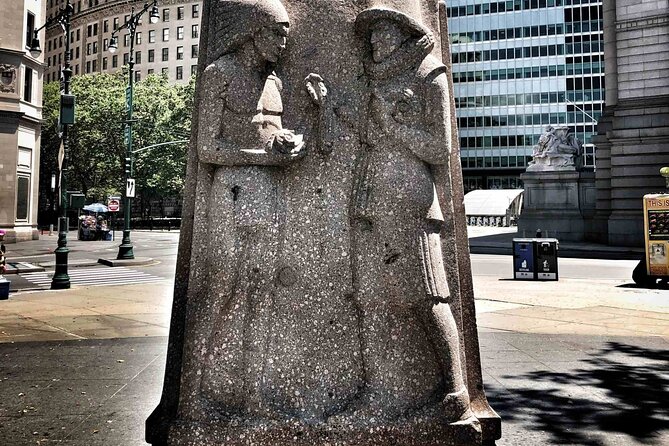
The tour passes by The Immigrants statue, and the audio focuses on the immigrant experience. It highlights Annie Moore, noted as the first immigrant to disembark at Ellis Island’s inspection station.
This is emotional history, but it’s also very concrete. Knowing a specific name and moment helps you connect the statue to the real-world scale of arrival and processing that shaped NYC.
If your travel style is “I want context, not just captions,” you’ll enjoy this stop. It gives the statue a story arc instead of leaving it as a background landmark.
East Coast Memorial and the Atlantic cost of WWII
After The Immigrants statue, you pass the East Coast Memorial, honoring American servicemen who lost their lives in the Atlantic during World War II.
This is another place where the audio makes your stop feel intentional. Even without museum tickets, you’ll get a clearer sense of what the memorial is marking and why the Atlantic coastlines are remembered this way.
I like that the tour doesn’t keep the history in one theme. It cycles from early defense to war stories to immigration, which makes the walk feel like an integrated overview of Lower Manhattan’s “pressure points.”
Carousel story: why a whimsical ride belongs next to fort history
Then you’ll come by the carousel inspired by the memory that Castle Clinton was once the New York Aquarium.
This is one of those surprising links that works great on an audio walk. Instead of treating the carousel as a cute distraction, you learn the connection that ties entertainment, changing waterfront uses, and the area’s evolving identity together.
It’s also a reminder that the Battery isn’t frozen in time. Even in a section famous for military history, the area kept changing roles.
Peter Minuit Plaza: wampum, the Dutchman, and buying Manhattan
As you move through Peter Minuit Plaza, you’ll hear how it’s named after the Dutchman who bought the island of Manahatta with wampum.
This stop adds an early “how NYC formed” layer that complements the fort-and-trading story from the Battery section. It gives you a broader timeline: settlement and commerce before wartime defenses.
If you like being able to place facts in order, this is a helpful anchor point.
Fraunces Tavern: learning from the oldest surviving building
Next you pass Fraunces Tavern, described as Manhattan’s oldest surviving building. The audio shares some of the amazing things that took place inside its walls.
I’d treat this as an information stop rather than a long pause. The tour helps you appreciate why the building is significant, and it works especially well if you’re the kind of visitor who likes to know what “happened here” before you move on.
And because it’s tied to the walking flow, you won’t feel like you’ve left the main story behind.
Stone Street finish: the cobbled stretch locals miss
The tour ends on Stone Street, in front of the cobbled stretch many lifelong New Yorkers never discover.
That final line is more than a fun fact. It’s a gentle nudge to keep exploring after the audio ends. Stone Street works well as a reward because it feels like a different mood from the formal memorial and fort history you just heard.
Also, it’s an easy place to keep your evening flexible. You can linger for atmosphere, or you can head onward without worrying you’ll miss a timed entry.
Timing, pacing, and what to wear
Plan for about 1 hour 30 minutes to 2 hours total. That’s a realistic window for a self-guided audio walk where you sometimes slow down for listening and looking.
You’re mostly outdoors, so dress for NYC weather, and wear comfortable shoes. If you know you’ll want longer pauses at memorials, build in extra time so you don’t feel rushed.
The tour is also available daily, 12:00 AM to 11:59 PM in the listed operating window. Since it’s self-guided, you’re not stuck matching a fixed departure time.
Who this tour is best for
This works well if you:
- Want a Lower Manhattan walk that feels guided without joining a group
- Like memorials and history but want clear context as you move
- Prefer offline touring with no Wi-Fi stress
- Want a “first visit” foundation for the Battery area before you expand to museums or neighborhoods
It’s less ideal if:
- You hate using apps outdoors
- You don’t travel with headphones
- You’re looking for an attraction with timed entry or a guided indoor experience (this doesn’t include museum tickets)
Should you book this Battery audio tour?
Yes, if you want a smart, self-paced way to understand why this waterfront zone mattered. The offline access, the lifetime replay value, and the mix of forts, war memorials, and immigrant history make it a strong use of a couple hours in Lower Manhattan.
I’d also book it if you’ve only got one shot at The Battery and you want more than surface sightseeing. The audio approach helps you notice what you’re passing, and it connects the stops into a coherent story you can carry with you as you explore NYC further.
FAQ
How long is the Battery: A Self-Guided Audio Tour from Bowling Green Park to Stone St?
It takes about 1 hour 30 minutes to 2 hours.
What does it cost?
It’s $14.99 per person.
Is the tour offered in English?
Yes, it’s available in English.
Do I need cell service or Wi-Fi?
No. The tour includes offline access to audio, maps, and geodata.
What should I bring with me?
You’ll need your smartphone and headphones. Tickets or entrance fees to attractions are not included.
When and where does the tour start?
It starts at Bowling Green Greenmarket on Broadway & Whitehall St, New York, NY 10004.
Where does the tour end?
It ends on Stone Street, Stone St, New York, NY 10004.
Does the tour include museum tickets or similar entry fees?
No. Tickets or entrance fees to museums or other attractions en route are not included.
Is this refundable if I cancel?
No. This experience is non-refundable and cannot be changed for any reason.
Let a Guide Handle It
- New York in One Day Guided Sightseeing Tour★ 5.0 · 13,166 reviews
- Central Park Pedicab Guided Tours★ 5.0 · 7,108 reviews
- From NYC: Guided Day Trip to Washington DC by Van or Bus★ 4.7 · 3,418 reviews
- NYC: Statue of Liberty and Ellis Island Guided Tour★ 4.6 · 2,765 reviews
- Original NYC Guided Food Tour of Chinatown and Little Italy★ 5.0 · 2,194 reviews
More Tours in New York City
- Statue of Liberty and Ellis Island Tour: All Options★ 5.0 · 13,571 reviews
- New York in One Day Guided Sightseeing Tour★ 5.0 · 13,166 reviews
- Central Park Pedicab Guided Tours★ 5.0 · 7,108 reviews
- New York City: Manhattan Helicopter Tour★ 4.7 · 7,076 reviews
- Private Central Park Pedicab Tour★ 5.0 · 6,981 reviews
More Tour Reviews in New York City
- NYC: SUMMIT One Vanderbilt Tickets★ 4.7 · 51,195 reviews
- NYC: Empire State Building Tickets – Observatory & Museum★ 4.7 · 25,757 reviews
- New York City: Statue of Liberty & Ellis Island with Ferry★ 4.6 · 18,683 reviews
- New York City: American Museum of Natural History Ticket★ 4.5 · 15,447 reviews
- Statue of Liberty and Ellis Island Tour: All Options★ 5.0 · 13,571 reviews
Just in: the newest New York City reviews on our desk





Audio Tours, compared.
 ★ 4.5Skyline Night Bus Audio Narrated Tour ExperienceFrom $49138 reviews
 ★ 3.5St. Patrick’s Cathedral Official Self-Guided Audio TourFrom $2045 reviews
 ★ 5.0Statue Of Liberty & Ellis Island Skip The Queue Audio Guide TourFrom $10119 reviews
 ★ 5.0A Gilded Age Audio Guide: New York’s Millionaire RowFrom $1413 reviews
 ★ 5.0Guided Tour (with Audio) Hamilton Musical in Lower Manhattan NYCFrom $4411 reviews
 ★ 4.5New York City’s Financial District: A Self-Guided Audio TourFrom $88 reviews
 ★ 5.0West Village’s Flappers, Freaks & Punks: A Self-Guided Audio TourFrom $114 reviews
 ★ 5.0New York City’s High Line: A Self-Guided Audio TourFrom $144 reviews
Browse the lists this tour appears in