
Reviewed · WALL STREET & FINANCIAL DISTRICT TOURS
New York City’s Financial District: A Self-Guided Audio Tour
Wall Street has a few stories you’d miss. With a self-guided Financial District audio tour, you can tap into the background fast and wander at your own speed. I especially liked the flexibility to start, stop, and skip stops, and the fact you can use offline audio so you’re not stuck hunting for cell signal. One drawback to know up front: the coverage can feel a bit surface-level if you want deep, name-by-name detail at every turn.
The experience is built for an easy walk through the Financial District, using your phone and GPS to trigger what to listen to where you are. You’ll move between a few iconic spots—some public-facing, some more institution-focused—and the narration is short enough to keep things moving without turning your afternoon into homework.
In This Review
- Key Points Worth Noticing
- Getting Oriented in New York’s Financial District (Without a Guide Herd)
- Price and What You Really Get for $8.99
- Where You Start and How the Route Ends
- How the Self-Guided Audio Works in Real Life
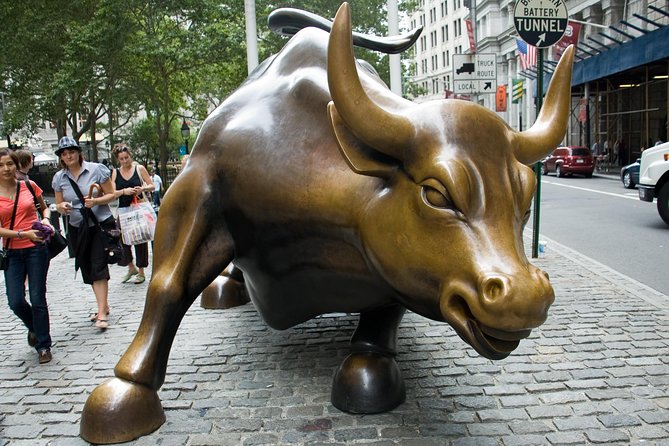
- Stop 1: Charging Bull—The Surprise Install Story (and Why It Stuck)
- Stop 2: The Federal Reserve—Gold Vaults Under Manhattan Bedrock
- Stop 3: Museum of American Finance—American Finance Through Exhibits
- Stop 4: The Building’s Neoclassical Details—Pantheon and Parthenon Echoes
- The Best Part: You Can Skip and Re-Do Without Losing the Thread
- Phone Needed, But You Don’t Need Data
- Who This Tour Suits Best
- Quick Timing and Pace Tips for a 30-Minute Route
- Should You Book This Financial District Audio Tour?
- FAQ
- How long is the Financial District self-guided audio tour?
- Where does the tour start and end?
- What language is the audio offered in?
- Do I need mobile data to use the tour?
- Can I skip stops or change my pace?
- Is admission included for any museums or attractions?
Key Points Worth Noticing

- GPS-guided audio helps you connect the story to the exact spot you’re standing near
- Start/stop anytime means you can pace it like a stroll, not a timed march
- Skip what you’re not feeling and still finish with a coherent route
- Offline access (audio, maps, geodata) helps when service is spotty
- Lifetime access lets you repeat the walk next time you’re in NYC
More history where the money moves
- NYC City Tour: Statue of Liberty, 9/11 Memorial, Wall Street
★ 4.5 · 2,059 reviews - Wall Street Insider Tour with a Finance Professional
★ 4.5 · 660 reviews - Wall Street Insider Tour with a Finance Professional
★ 4.5 · 571 reviews - Manhattan Group Tour Including Wall Street and 911 Memorial
★ 5.0 · 408 reviews
Getting Oriented in New York’s Financial District (Without a Guide Herd)
This kind of tour is made for one simple goal: help you read the streets of the Financial District like a map with a voice. Instead of following a group and hoping the timing lines up with your curiosity, you’re in control. You choose when to start, when to pause, and which stops deserve your attention.
The tech angle matters more than you might think. You’re not just listening to a script on loop. VoiceMap uses GPS so the audio lines up with the places you pass. That turns a random walk past big names—Wall Street landmarks and major institutions—into something you can actually remember.
And here’s the practical part: you can also take it again later thanks to lifetime access. So if your first run ends with you craving more, you can come back and tighten the route to what you care about.
Price and What You Really Get for $8.99
At $8.99 per person for roughly 30 minutes, this is priced like an add-on you can fit into a tight NYC plan. The value comes from two things that are clear in the setup: you get offline access and lifetime access.
Offline access isn’t just a convenience perk. In the Financial District, you can hit weird dead zones and busy pockets where signal is inconsistent. Having audio and mapping available without relying on mobile data means you lose fewer minutes. Lifetime access means you’re not paying again later just to do a second pass when you have different interests—finance, architecture, or pure street-story curiosity.
If you want the kind of tour where someone hands you a thick timeline with lots of digressions, you might find the pacing a bit light. But if you want an efficient “what am I looking at and why does it matter?” walk, this price makes sense.
Where You Start and How the Route Ends
You begin at the National Museum of the American Indian, 1 Bowling Green, New York, NY 10004. Your walk finishes at Total Bid Data Corp, 48 Wall St, New York, NY 10005.
That start point is convenient if you’re already in the Bowling Green area, and ending around Wall Street means you’re not awkwardly backtracking to your starting point. Since the tour is self-guided, you’re not locked to a strict start time beyond when you choose to begin listening.
You’ll also get directions to the starting point so the experience can start when you’re actually in the right place.
More days made simple with a guide




How the Self-Guided Audio Works in Real Life
You use the VoiceMap application on your phone. The tour is offered in English, and it runs on a voice narrator that you listen to as you walk.
A few practical tips based on how these GPS audio tours typically behave—and based on what this one is built to do:
- Download the tour data for offline use before you start, so you’re not draining your battery chasing reception.
- Bring headphones you’re comfortable with. You’ll want clear narration while staying aware of traffic and pedestrians.
- Keep an eye on your phone’s battery. The tour won’t work properly if your device dies mid-walk.
One more good note: it’s listed as a private tour/activity, meaning only your group participates. So you’re not competing for audio attention with strangers.
Stop 1: Charging Bull—The Surprise Install Story (and Why It Stuck)
This tour kicks off with Charging Bull on Wall Street. The audio focuses on the story of how it was installed—by surprise and without permission in 1989—and the fact it’s still there today.
That alone is a perfect example of what a street-level story adds. A bull statue can look like just another photo-op. But a short backstory—especially one involving an unauthorized surprise installation—turns it into a city legend you can carry with you.
Why this stop is worth your time:
- It’s instantly recognizable, so you can anchor the tour in something you already know.
- The narration gives you context you can spot immediately, which makes later stops click faster.
Possible downside: if you’re expecting a long deep-dive into every detail around the sculpture, you may find the segment brief. The tour overall can be quick-and-smooth rather than encyclopedic.
Stop 2: The Federal Reserve—Gold Vaults Under Manhattan Bedrock
Next up is the Federal Reserve. The narration frames it as the main bank for the United States and explains that it sets monetary policy that guides the country’s economy.
Then it zooms in on a specific physical detail that’s both dramatic and easy to visualize: the Federal Reserve contains the largest reserve of gold in the world, and the vault sits 80 feet below street level, directly on Manhattan bedrock.
This stop works well because it blends two types of knowledge:
- Big-picture role in the economy
- A concrete, place-based fact that makes the institution feel tangible
And that’s what I like about the way the tour is organized. Even if you don’t consider yourself a finance person, you’re still getting a mental picture: policy above, vault below, all in one walking route.
One consideration: the Federal Reserve is an active institution. Your experience is about the storytelling around what you’re seeing from the public street. The audio is designed for that reality, not for entering restricted areas.
Stop 3: Museum of American Finance—American Finance Through Exhibits
After the Federal Reserve, the route highlights the Museum of American Finance, described as an independent institute preserving and exhibiting historical media related to American finance. It’s also noted as an affiliate of the Smithsonian Institute.
Even without stepping inside (and the tour description doesn’t spell out an included admission), the museum itself becomes a “why it matters” stop. You’re not just hearing that finance exists—you’re shown where stories about it are preserved.
What makes this stop interesting on a self-guided route:
- It shifts the focus from current institutions to historical record.
- It gives you a clear reason the museum exists, not just a name to remember.
If you’re the type who likes to pair your street walk with one smart follow-up, you may find this stop nudges you to look up hours and ticket info on your own afterward.
Stop 4: The Building’s Neoclassical Details—Pantheon and Parthenon Echoes
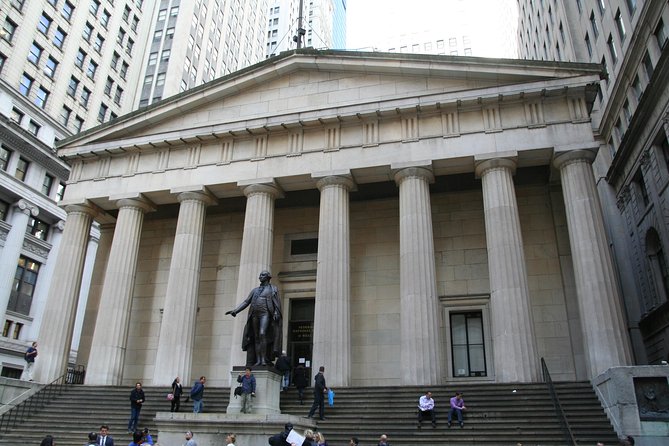
The final listed stop zeroes in on the building itself: the current neoclassical structure was completed in 1842. The façade is described as reminiscent of the Parthenon in Athens, and the domed interior rotunda is modeled after the Pantheon in Rome.
This is the kind of architectural detail that can be easy to miss when you’re rushing past. But once you’re told to look for it, the building becomes more than a backdrop. It turns into a clue that NYC’s Financial District doesn’t just run on money—it’s also shaped by older European design language.
Why this matters for your walk:
- It adds a visual “spotting challenge.”
- It makes the area feel less like a maze of banks and more like a curated city of ideas.
Again, don’t expect an architectural lecture. This tour is designed to keep moving and keep listening short and usable.
The Best Part: You Can Skip and Re-Do Without Losing the Thread
The highlights list makes the big promise: you can start and stop when you want, and you can skip any stops you’re not interested in. That isn’t just convenience. It changes how you experience the route.
If you’re there for Wall Street stories, you can keep your focus on Charging Bull. If you’re more fascinated by institutions, you can center the Federal Reserve segment. If you care about architecture or museums, you can prioritize those stops.
And because you’ve got lifetime access, your second attempt can be different. Maybe you’ll want a slower pass. Maybe you’ll want to skip the parts you already “got.”
This is also where the reviews point to real-world usefulness—people appreciated being able to control the flow and the tech that supports it, including the ability to hear the narration on a device while walking as a group.
Phone Needed, But You Don’t Need Data
One practical note: the tour does not include a smartphone. You’ll need your own device, the VoiceMap app, and whatever it takes to keep the audio playing.
The included offline access (audio, maps, and geodata) is a big deal. It lowers friction and reduces stress. Instead of thinking about reception every few blocks, you can just walk.
If you’re the type who hates “turn-by-turn dependency,” you’ll probably like this format. You’re listening for the story and checking your progress visually rather than being stuck following complicated routing.
Who This Tour Suits Best
This is a strong fit if you:
- Want a 30-minute Financial District walk with clear stops
- Like finance-related facts without committing to a long guided tour
- Prefer flexibility—start when you want, pause when you want
- Want offline audio so you can keep exploring without data anxiety
- Plan to return to NYC and might repeat the walk later
It may be less ideal if you:
- Want heavy detail at every stop (you may feel the info stays at a high level)
- Expect a lot of “inside access” or timed entry included in the experience (the description doesn’t indicate that)
Quick Timing and Pace Tips for a 30-Minute Route
Since the duration is listed as about 30 minutes, treat it like a “grab the highlights” walk. That means:
- Don’t overpack the schedule before or after. You’ll want a little breathing room if you linger at Charging Bull or stop for photos.
- If you’re skipping segments, you can still finish comfortably, because the route is modular.
Also, the tour availability is listed as 12:00 AM–11:59 PM across the listed period. That suggests you can do it at times that fit your day—not just during a narrow window.
Should You Book This Financial District Audio Tour?
I’d book it if you want a low-cost, flexible way to turn a Financial District walk into something you can actually understand and remember—especially if you care about a few big anchor stops like Charging Bull, the Federal Reserve’s gold vault, and the Museum of American Finance building details.
Skip it if you’re chasing deep, heavy analysis or a lot of layered storytelling per stop. At $8.99, the goal here is fast value, not a thick textbook.
If your NYC day is packed and you want one smart, self-paced option that works even when signal is unreliable, this is the kind of ticket you’ll appreciate using right away—and again next time you’re back in town.
FAQ
How long is the Financial District self-guided audio tour?
It takes about 30 minutes, approximately.
Where does the tour start and end?
It starts at the National Museum of the American Indian, 1 Bowling Green, and ends at Total Bid Data Corp, 48 Wall St.
What language is the audio offered in?
The tour is offered in English.
Do I need mobile data to use the tour?
No. It includes offline access to audio, maps, and geodata.
Can I skip stops or change my pace?
Yes. You can start and stop at any time and skip stops you’re not interested in.
Is admission included for any museums or attractions?
The tour price does not include admission fees for personal expenses not included during the tour.
More Tours in New York City
- Statue of Liberty and Ellis Island Tour: All Options★ 5.0 · 13,571 reviews
- New York in One Day Guided Sightseeing Tour★ 5.0 · 13,166 reviews
- Central Park Pedicab Guided Tours★ 5.0 · 7,108 reviews
- New York City: Manhattan Helicopter Tour★ 4.7 · 7,076 reviews
- Private Central Park Pedicab Tour★ 5.0 · 6,981 reviews
More Tour Reviews in New York City
- NYC: SUMMIT One Vanderbilt Tickets★ 4.7 · 51,195 reviews
- NYC: Empire State Building Tickets – Observatory & Museum★ 4.7 · 25,757 reviews
- New York City: Statue of Liberty & Ellis Island with Ferry★ 4.6 · 18,683 reviews
- New York City: American Museum of Natural History Ticket★ 4.5 · 15,447 reviews
- Statue of Liberty and Ellis Island Tour: All Options★ 5.0 · 13,571 reviews
Where Wall Street Was Built
- NYC City Tour: Statue of Liberty, 9/11 Memorial, Wall Street★ 4.5 · 2,059 reviews
- Wall Street Insider Tour with a Finance Professional★ 4.5 · 660 reviews
- Wall Street Insider Tour with a Finance Professional★ 4.5 · 571 reviews
- Manhattan Group Tour Including Wall Street and 911 Memorial★ 5.0 · 408 reviews
- Private New York Tour: Footsteps of Alexander Hamilton★ 5.0 · 402 reviews
Just in: the newest New York City reviews on our desk





Wall Street & Financial District Tours, compared.
 ★ 4.5NYC City Tour: Statue of Liberty, 9/11 Memorial, Wall StreetFrom $392,059 reviews
 ★ 4.5Wall Street Insider Tour with a Finance ProfessionalFrom $39660 reviews
★ 4.5Wall Street Insider Tour with a Finance ProfessionalFrom $39571 reviews
★ 4.5Wall Street Insider Tour with a Finance ProfessionalFrom $39660 reviews
★ 4.5Wall Street Insider Tour with a Finance ProfessionalFrom $39571 reviews
 ★ 5.0Manhattan Group Tour Including Wall Street and 911 MemorialFrom $39408 reviews
 ★ 5.0Private New York Tour: Footsteps of Alexander HamiltonFrom $60402 reviews
 ★ 4.6Wall Street Tour with 9/11 Memorial and Statue FerryFrom $39367 reviews
 ★ 4.9Wall Street and Financial District Walking TourFrom $34284 reviews
 ★ 5.0How Money Was Made Wall Street Walking TourFrom $49185 reviews
Browse the lists this tour appears in