
Reviewed · SOHO, CHINATOWN & LITTLE ITALY TOURS
The Original SoHo, Little Italy, Chinatown Walking Tour
Lower Manhattan tells stories through food. This 1 hour 30 minute walking tour moves you through the overlap of Chinatown, Little Italy, and nearby SoHo sights, with a local guide and plenty to taste. I especially like how you focus on Mott and Mulberry Streets and what immigrant life looked like for people arriving in the 1800s.
I also like the way the route uses food samples to keep the history concrete. You’ll refuel with Chinese pork buns and dumplings, New York-style pizza, Italian gelato, and more, then round things out with an included cannoli stop.
One consideration: the group stays small (max 15), but the walking pace is steady, so wear comfy shoes and plan to snack slowly rather than inhaling treats on the go.
In This Review
- Key highlights worth your attention
- Where this Lower Manhattan route starts and why it matters
- Chinatown on Mott and Mulberry: more than menus and storefronts
- Little Italy: the same streets, a different lens
- The Church of the Transfiguration: a quiet pause with real staying power
- Cannoli King at Caffè Palermo: why the “included” sweet matters
- What you’re really paying for: $49 and the value of guidance plus snacks
- Timing, pacing, and how to get the best from 90 minutes
- Who should book this tour (and who might want to choose differently)
- Should you book the Original SoHo, Little Italy, Chinatown Walking Tour?
- FAQ
- How long is the walking tour?
- What does the tour cost?
- Where does the tour start and end?
- How many people are in the group?
- Is the ticket mobile?
- What stops are included?
- What food will I sample?
- Is the church stop admission free?
- Is the cannoli stop included in the price?
- Can I cancel for a full refund?
Key highlights worth your attention
- Small group, personal questions: Max 15 people means it’s easier to ask follow-ups and hear street-level details.
- Mott and Mulberry Streets focus: The heart of the story here is right in front of you.
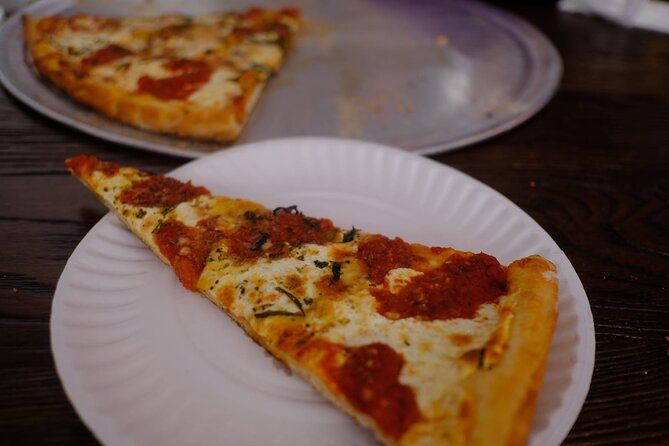
- Food at multiple stops: Chinese pork buns, dumplings, New York-style pizza, Italian gelato, and an included cannoli.
- Church with staying power: The Church of the Transfiguration was completed in 1801 and served immigrant worship for over 200 years.
- A long-running pastry stop: Caffè Palermo has been serving since 1973, tied to the Cannoli King tradition.
- Built for a quick win: In about 90 minutes, you get history, street scenes, and bites without committing to a half day.
Keep tasting downtown: SoHo, Chinatown and Little Italy
- SoHo, Little Italy, and Chinatown Walking Tour in New York
★ 5.0 · 3,153 reviews - NYC: Chinatown & Little Italy Food Tour with 7 Flavorful Tastings
★ 5.0 · 2,733 reviews - Original NYC Guided Food Tour of Chinatown and Little Italy
★ 5.0 · 2,194 reviews - NYC Food Tour: Chinatown and Little Italy
★ 5.0 · 1,090 reviews
Where this Lower Manhattan route starts and why it matters
The tour begins at Spring Street Park (Spring St) and ends at Columbus Park at Mulberry Street & Baxter St. That matters because the route is designed to keep you in the Lower Manhattan pocket where Chinatown and Little Italy blur into each other.
I like that you’re not getting shoved across town. Instead, you’re walking the streets that feel lived-in, with a mix of older blocks and newer creative energy. The tour description even points to SoHo’s newer art and culture hubs nearby, so you’ll catch that contrast while staying in one easy-to-follow area.
If you want to get your bearings fast in this part of NYC, this format is solid. It’s short enough that you still have time to wander afterward, but structured enough that you won’t miss the little patterns in the streets.
Chinatown on Mott and Mulberry: more than menus and storefronts
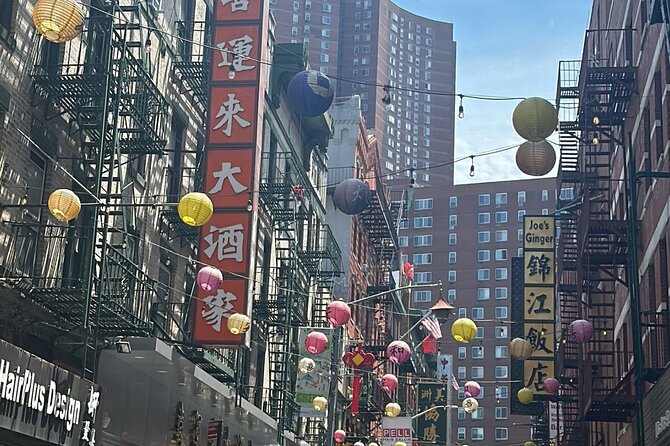
Your first stop is Chinatown, with about 30 minutes on the ground around Mott and Mulberry Streets. The big idea here is that this isn’t treated like a theme park. You’re walking through one of the best-preserved areas of old Manhattan while learning what immigrant life was like for people arriving in the 1800s.
You also get a modern layer. Along the same streets, you’ll check out what’s happening now—art and architecture changes that show how the neighborhood keeps evolving while still carrying older identities. That pairing is what I find useful: it gives you a reason to look at facades, not just shop windows.
Then come the bites. At this stage, you’ll start sampling a spread that includes Chinese pork buns and dumplings, plus New York-style pizza and Italian gelato among the options listed for the stops in this stretch. Even if you’re not a “food tour” person, tasting helps you slow down and pay attention. You notice what people choose to buy, what’s comforting, and what feels familiar.
Possible drawback at this stop: if you’re sensitive to walking-and-eating timing, you may want to plan for a slightly rushed rhythm during samples. This is a short tour, so the guide keeps things moving.
Little Italy: the same streets, a different lens
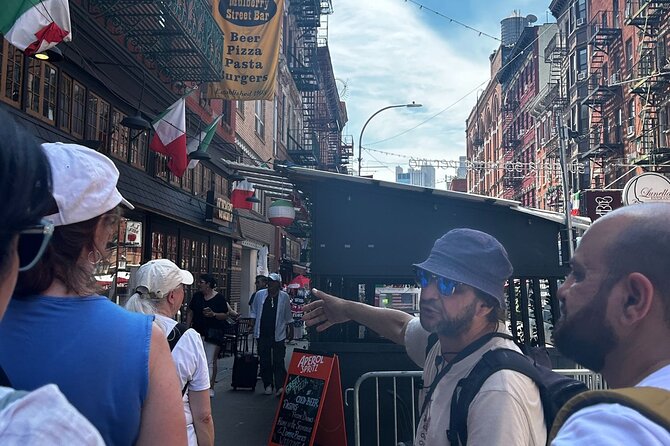
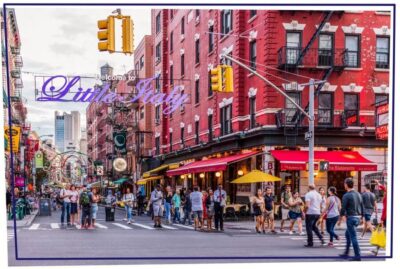
The tour’s second walking stop is Little Italy, also about 30 minutes, and it keeps you in the same general streetscape area. Yes, the itinerary text repeats the same street focus, but the value is in how the story shifts. You’re still anchored on Mott and Mulberry Streets, still shown how immigrant arrival shaped the neighborhood, and still pointed toward the blend of old Manhattan and newer culture.
This is the part where I think the guide’s role matters most. On your own, it’s easy to treat Little Italy like a postcard loop. With a guide, you get the “why” behind what you see—how communities formed, how they shared space, and why certain streets became corridors for daily life.
Food keeps the pacing friendly. The sampling list for this section also includes items like pizza and gelato, plus Chinese dumplings and pork buns being part of what you’ll try during the overall Chinatown/Little Italy stretch. That mix is useful. It helps you see the neighborhoods as overlapping, not locked into neat borders.
Tip I’d give you: use this stop to decide what you want to follow up on later. If one snack hits harder than the rest, that’s your clue about what to seek out when the tour ends.
New York City at street level, a few more walks
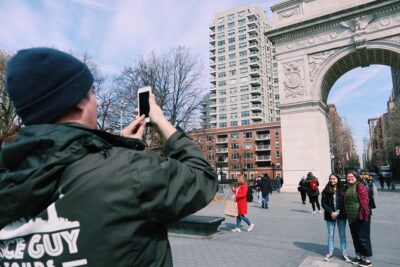
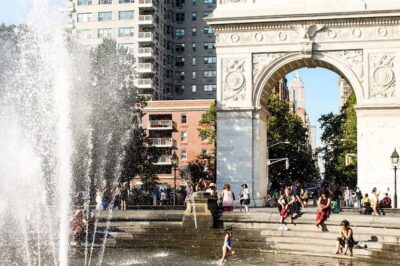
The Church of the Transfiguration: a quiet pause with real staying power
One of the best parts of this tour is the mid-route break at the Church of the Transfiguration, about 10 minutes. The description is clear on the key fact: it was completed in 1801, and it became a center of worship for immigrant groups of the neighborhood for over 200 years.
You’re not there for a long ceremony. You’re there to see how the neighborhood structured life beyond work and food. A church like this functions like a social anchor: it’s where people gathered, where community identity stayed intact, and where daily routines gained meaning.
This stop is short, but it changes the energy of the walk. After the back-to-back tasting stops, stepping into something that has endured for so long helps the whole tour click together. You start linking the food and street scenes to the actual people and institutions that shaped their days.
If you like places with a sense of continuity—buildings that have been in the frame for generations—this is the stop that tends to linger.
Cannoli King at Caffè Palermo: why the “included” sweet matters
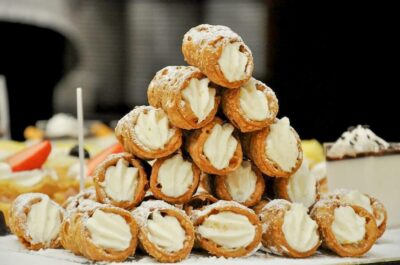
Your final food-focused stop is Cannoli King at Caffè Palermo, about 10 minutes. Here’s the detail that makes it more than just a dessert stop: Caffè Palermo has provided pastries since 1973, and it’s described as the home of the Cannoli King for 51 years.
That’s a different kind of value than sampling one-and-done sweets. You’re connecting with a legacy business that’s been serving the neighborhood and visitors for decades. And because the stop includes admission, you know you’re getting a real payoff at the end rather than a vague promise of dessert.
A practical note: cannoli is rich. If you’ve been eating tastings back-to-back, plan a slower approach here. Let it be the finale, not a snack you shovel in while still processing earlier bites.
End point matters, too. You finish at Columbus Park (Mulberry Street & Baxter St). That’s a handy place to stand, regroup, and decide what’s next—whether that’s wandering a few more blocks or grabbing a drink nearby before you call it a night.
What you’re really paying for: $49 and the value of guidance plus snacks
At $49 per person, the tour isn’t priced like a budget stroll, but it also isn’t trying to be a full-day production. For me, the value comes from three places.
First, the guide. The tour is built around local history and stories that you won’t reliably pick up just by walking the streets and reading signs. In a neighborhood where the boundaries blur, having someone point out patterns saves you time and helps you understand what you’re seeing.
Second, the group size. With a maximum of 15 travelers, you’re more likely to get personal attention and a chance to ask questions. That changes the vibe from you following a line of people to you moving with a group that can actually interact.
Third, the food sampling. You’re listed as trying items that include Chinese pork buns, dumplings, New York-style pizza, and Italian gelato, plus the cannoli included at the Cannoli King stop. Even if you don’t treat each sample like a full meal, the variety is meaningful. You’re paying for a guided route that also helps you experience multiple parts of the neighborhood in one go.
If your goal is to cover Chinatown and Little Italy efficiently while also eating well, $49 starts to make sense fast.
Timing, pacing, and how to get the best from 90 minutes
This tour runs about 1 hour 30 minutes and uses a mobile ticket. That means you can spend your time focusing on the walk, not juggling paper or worrying about complex check-in rituals.
Here’s how I’d plan for the pace:
- Wear comfortable shoes for uneven sidewalk moments.
- Bring a small water bottle if you run warm, since you’ll be sampling and stopping.
- If you have dietary restrictions, think about how you’ll handle tasting portions. The itinerary lists specific sample types, but it doesn’t spell out alternatives, so it’s worth checking directly.
The itinerary format is also useful: it keeps you moving with clear segments—Chinatown first, then Little Italy, then a short landmark pause, and finally the included cannoli stop. That structure is why this tour works as a repeatable favorite. When you’re back in NYC and want a quick orientation through Lower Manhattan’s overlap zones, it’s easy to slot into your day.
And yes, if you’re the kind of person who likes comparing guides, this tour seems designed to change slightly depending on who you get. The tour is consistently praised for staying informative and well-paced, even when the guide varies.
Who should book this tour (and who might want to choose differently)
This is a great pick if you want all of these things at once:
- A short Lower Manhattan plan that covers Chinatown and Little Italy
- A guide-focused experience with small-group attention
- Food sampling that includes Chinese dumplings, NY-style pizza, Italian gelato, and an included cannoli
- A stop at a historic place like the Church of the Transfiguration (completed 1801)
It might not be your best match if you prefer long stays at a single site or you hate walking-and-snacking pacing. The tour is compact, so it’s more about seeing connections quickly than doing slow, museum-style time.
Should you book the Original SoHo, Little Italy, Chinatown Walking Tour?
If you’re trying to understand Lower Manhattan beyond the obvious highlights, I think this one is worth booking. The combination of street history, a landmark church stop that reaches back to 1801, and an ending cannoli tradition that’s been around since 1973 gives the route a strong sense of continuity. And the food sampling is built into the experience rather than added on later.
Book it if you want a fun, efficient way to get oriented fast, eat well, and leave with more than a list of names. Skip it if you want long stops, silent sightseeing, or lots of downtime. Otherwise, this is the kind of tour you can enjoy more than once because the neighborhood stories keep their relevance the moment you step back onto the sidewalk.
FAQ
How long is the walking tour?
It lasts about 1 hour 30 minutes (approx.).
What does the tour cost?
The price is $49.00 per person.
Where does the tour start and end?
It starts at Spring Street Park on Spring St and ends at Columbus Park on Mulberry Street & Baxter St.
How many people are in the group?
The tour has a maximum of 15 travelers.
Is the ticket mobile?
Yes, the tour uses a mobile ticket.
What stops are included?
The tour includes Chinatown, Little Italy, the Church of the Transfiguration (completed in 1801), and Cannoli King at Caffè Palermo.
What food will I sample?
The food list includes Chinese pork buns and dumplings, New York-style pizza, Italian gelato, and more, plus cannoli at the included stop.
Is the church stop admission free?
The tour lists free admission ticket for the Church of the Transfiguration stop.
Is the cannoli stop included in the price?
Yes. The Cannoli King stop lists admission included.
Can I cancel for a full refund?
Yes. You can cancel up to 24 hours in advance for a full refund. If you cancel less than 24 hours before the start time, the amount paid is not refunded.
More Tour Reviews in New York City
- NYC: SUMMIT One Vanderbilt Tickets★ 4.7 · 51,195 reviews
- NYC: Empire State Building Tickets – Observatory & Museum★ 4.7 · 25,757 reviews
- New York City: Statue of Liberty & Ellis Island with Ferry★ 4.6 · 18,683 reviews
- New York City: American Museum of Natural History Ticket★ 4.5 · 15,447 reviews
- Statue of Liberty and Ellis Island Tour: All Options★ 5.0 · 13,571 reviews
New York City, One Block at a Time
- SoHo, Little Italy, and Chinatown Walking Tour in New York★ 5.0 · 3,153 reviews
- Secrets of Grand Central Station Walking Tour New York City★ 5.0 · 1,796 reviews
- Greenwich Village Walking and Food Tasting Tour★ 5.0 · 1,572 reviews
- Artistic, Alternative Greenwich Village Walking Tour★ 5.0 · 971 reviews
- Brooklyn Bridge & DUMBO Neighborhood Tour – from Manhattan to Brooklyn★ 5.0 · 826 reviews
Downtown Bites: SoHo to Little Italy
- SoHo, Little Italy, and Chinatown Walking Tour in New York★ 5.0 · 3,153 reviews
- NYC: Chinatown & Little Italy Food Tour with 7 Flavorful Tastings★ 5.0 · 2,733 reviews
- Original NYC Guided Food Tour of Chinatown and Little Italy★ 5.0 · 2,194 reviews
- NYC Food Tour: Chinatown and Little Italy★ 5.0 · 1,090 reviews
- NYC: Chinatown and Little Italy Food Tour★ 4.7 · 703 reviews
Just in: the newest New York City reviews on our desk





SoHo, Chinatown & Little Italy Tours, compared.
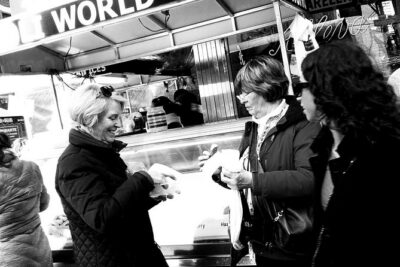 ★ 5.0SoHo, Little Italy, and Chinatown Walking Tour in New YorkFrom $393,153 reviews
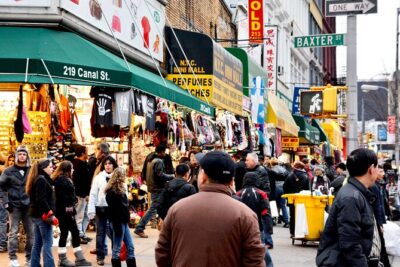 ★ 5.0Chinatown & Little Italy Food Tour with 7 Flavorful TastingsFrom $992,733 reviews
 ★ 5.0Original NYC Guided Food Tour of Chinatown and Little ItalyFrom $1302,194 reviews
 ★ 4.7Chinatown and Little Italy Food TourFrom $80703 reviews
 ★ 4.7SoHo, Little Italy, and Chinatown Guided TourFrom $30614 reviews
 ★ 4.6SoHo, Little Italy, and Chinatown 2-Hour Guided WalkFrom $39566 reviews
 ★ 5.0SoHo, Little Italy, and Chinatown NYC Guided Walking TourFrom $36443 reviews
Browse the lists this tour appears in